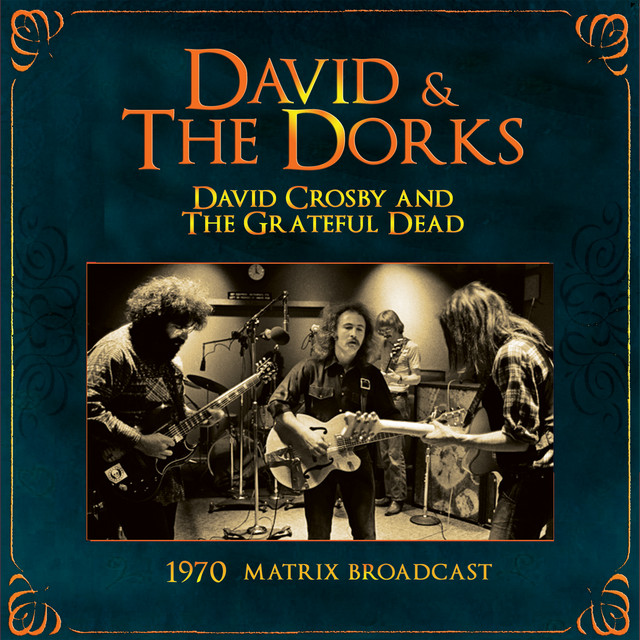
Don’s Pick tonight is The David & The Dorks Sessions, captured during a December 1970 performance at The Matrix
 DJ Don Edwards
The Grateful Dead Live: The David & The Dorks Sessions and a Legendary San Francisco Collaboration
Live music has always been the lifeblood of the Grateful Dead, a group whose entire identity was built on the idea that songs should evolve every time they are played. For fans of improvisational rock, the band’s concerts were never just performances—they were unpredictable musical journeys where folk, blues, psychedelic rock, and jazz improvisation blended into something entirely new each night.
Among the countless recordings circulating through the vast archive of Grateful Dead history, one collaboration stands out as a particularly intriguing and often overlooked chapter: the brief but fascinating partnership between David Crosby and members of the Grateful Dead during the winter of 1970.
For a short moment in time, Crosby joined forces with several members of the Dead to form a loose collective known as David & The Dorks, a project that embodied everything adventurous about the San Francisco music scene at the turn of the decade.
The recordings from that collaboration—captured during a December 1970 performance at The Matrix—remain one of the most fascinating documents of spontaneous musical experimentation from that era.
For listeners who crave the authenticity of live music and rare recordings, these sessions offer a powerful reminder of how freely musicians were willing to push boundaries during the early years of the American rock movement.
And for audiences tuning in to Don’s Pick, the celebrated Saturday night radio program curated by Don, this kind of musical exploration sits squarely at the heart of what the show celebrates every week.
The San Francisco Sound and the Birth of Improvisational Rock
By 1970, the San Francisco music scene had already transformed the landscape of American rock music. Bands emerging from the Bay Area were experimenting with longer song structures, extended improvisations, and a spirit of collaboration that blurred the lines between genres.
The Grateful Dead stood at the center of that movement.
Formed in the mid-1960s, the band quickly developed a reputation for concerts that stretched songs into sprawling musical conversations. Rather than performing rigid arrangements, they allowed songs to grow organically on stage.
That philosophy made collaboration almost inevitable.
Musicians frequently sat in with one another during performances, creating one-night musical combinations that would never be repeated again.
In December of 1970, one of those spontaneous collaborations produced a project that remains a hidden gem in rock history.
David Crosby Joins the Grateful Dead
During that period, David Crosby was already widely recognized as one of the most influential voices in American music. As a founding member of Crosby, Stills, Nash & Young, Crosby had helped redefine the possibilities of harmony-driven rock songwriting.
But Crosby also possessed a deep appreciation for improvisational music.
When he joined Jerry Garcia, Phil Lesh, and Mickey Hart for a series of informal sessions in San Francisco, the result was something uniquely creative.
The collaboration became known simply as David & The Dorks—a name that perfectly captured the loose, playful spirit of the project.
There was no formal album plan.
No carefully orchestrated tour schedule.
No pressure to create radio hits.
Instead, the musicians gathered simply to play.
The Matrix Broadcast: December 15, 1970
One of the most important recordings from this collaboration comes from a performance broadcast by KSAN 95 FM on December 15, 1970 at The Matrix nightclub in San Francisco.
The venue itself was legendary in the early days of psychedelic rock. Founded by Jefferson Airplane’s Marty Balin, The Matrix became a hub for experimental performances and intimate concerts where musicians could stretch beyond traditional formats.
The broadcast captured eight songs performed live on the air, offering listeners a rare glimpse into the chemistry between Crosby and members of the Grateful Dead.
The performance blends traditional American roots music with exploratory improvisation. Folk ballads, blues standards, and original compositions drift in and out of extended jams as the musicians explore each song from multiple directions.
Crosby’s soaring vocal tone floats over Garcia’s fluid guitar lines, while Lesh’s melodic bass playing and Hart’s rhythmic textures provide a dynamic foundation.
The music feels spontaneous and unfiltered—exactly the kind of creative environment that defined the San Francisco scene.
A Loose, Improvisational Masterpiece
What makes the David & The Dorks recording so compelling is its relaxed atmosphere.
Unlike the massive arena concerts the Grateful Dead would eventually headline, the Matrix performance feels intimate and exploratory. The musicians are clearly enjoying the freedom to experiment.
Songs drift into unexpected directions.
Melodies stretch beyond their original structures.
Guitar phrases turn into extended improvisational passages that seem to evolve organically with each measure.
For fans of the Grateful Dead’s improvisational style, the session offers a fascinating glimpse into how Garcia approached collaboration outside of the band’s core lineup.
Crosby’s presence adds an entirely new texture to the sound, merging the Dead’s psychedelic roots with the harmony-driven songwriting of Crosby’s folk-rock background.
Rehearsals and Hidden Tracks
In addition to the live broadcast material, surviving recordings from this period also include several rehearsal performances captured before the Matrix show.
These rehearsal tapes provide an even deeper look into the creative process.
Without the pressure of a live audience, the musicians experiment with arrangements, test musical ideas, and explore transitions between songs.
The recordings capture a moment when some of the most innovative musicians of the era were simply enjoying the act of making music together.
Why the Collaboration Matters
While the David & The Dorks project never evolved into a long-term band, it represents something essential about the musical culture of the early 1970s.
Artists were constantly collaborating.
Genres were fluid.
Creative experimentation was encouraged rather than restrained.
For the Grateful Dead, these kinds of collaborations reinforced their reputation as one of the most open-minded bands in rock history.
For David Crosby, the sessions demonstrated his willingness to explore musical spaces beyond the structured songwriting that defined Crosby, Stills, Nash & Young.
The result is a recording that feels less like a polished product and more like a window into a creative moment.
The Enduring Power of Live Grateful Dead Recordings
One of the reasons the Grateful Dead continue to attract new listeners decades after their final tours is the extraordinary depth of their live recording archive.
Thousands of concerts exist in various forms—official releases, radio broadcasts, and fan recordings captured by the legendary community of Deadhead tapers who documented the band’s performances.
Each recording tells a different story.
Some nights feature tight, focused playing.
Others explode into sprawling improvisational journeys.
But every performance reflects the band’s belief that live music should never be predictable.
The David & The Dorks sessions embody that philosophy perfectly.
Don’s Pick: Saturday Night Music Discovery
The spirit of musical exploration found in recordings like these is exactly what drives Don’s Pick, the highly anticipated Saturday night radio program hosted by Don.
Every week, the show presents a carefully curated selection of music drawn from across genres and eras. Rather than following predictable playlists, Don selects songs based on passion, knowledge, and the desire to introduce listeners to remarkable recordings they might not otherwise encounter.
The program celebrates music’s diversity—blending classic rock, live recordings, rare performances, and unexpected discoveries into a single listening experience.
For fans of improvisational music and historic live recordings, Don’s Pick provides a platform where legendary moments in music history can be rediscovered and appreciated all over again.
Shows like the David & The Dorks broadcast are exactly the kind of hidden treasures that make live music so exciting.
A Rare Moment in Rock History
More than fifty years after the Matrix performance took place, the David & The Dorks recordings remain a fascinating snapshot of a moment when some of rock music’s most adventurous artists gathered simply to see where the music would take them.
There were no expectations.
No commercial pressures.
Just musicians responding to each other in real time.
For listeners who love the improvisational spirit of the Grateful Dead, the recordings stand as a reminder that the band’s legacy extends far beyond their official albums.
Their influence lives in every spontaneous jam, every unexpected collaboration, and every live performance where musicians abandon structure and follow the music wherever it leads.
And when the right recording surfaces—whether on vinyl, streaming platforms, or the airwaves of Don’s Pick—that spirit returns once again.
Because in the world of the Grateful Dead, the music was never meant to stay frozen in time.
It was always meant to keep evolving.