On This Day: April 18, 1982 — The Night the Grateful Dead Shook Hartford to Its Core — Don's Pick Tonight on The Grateful Dead Live!
 DJ Don Edwards
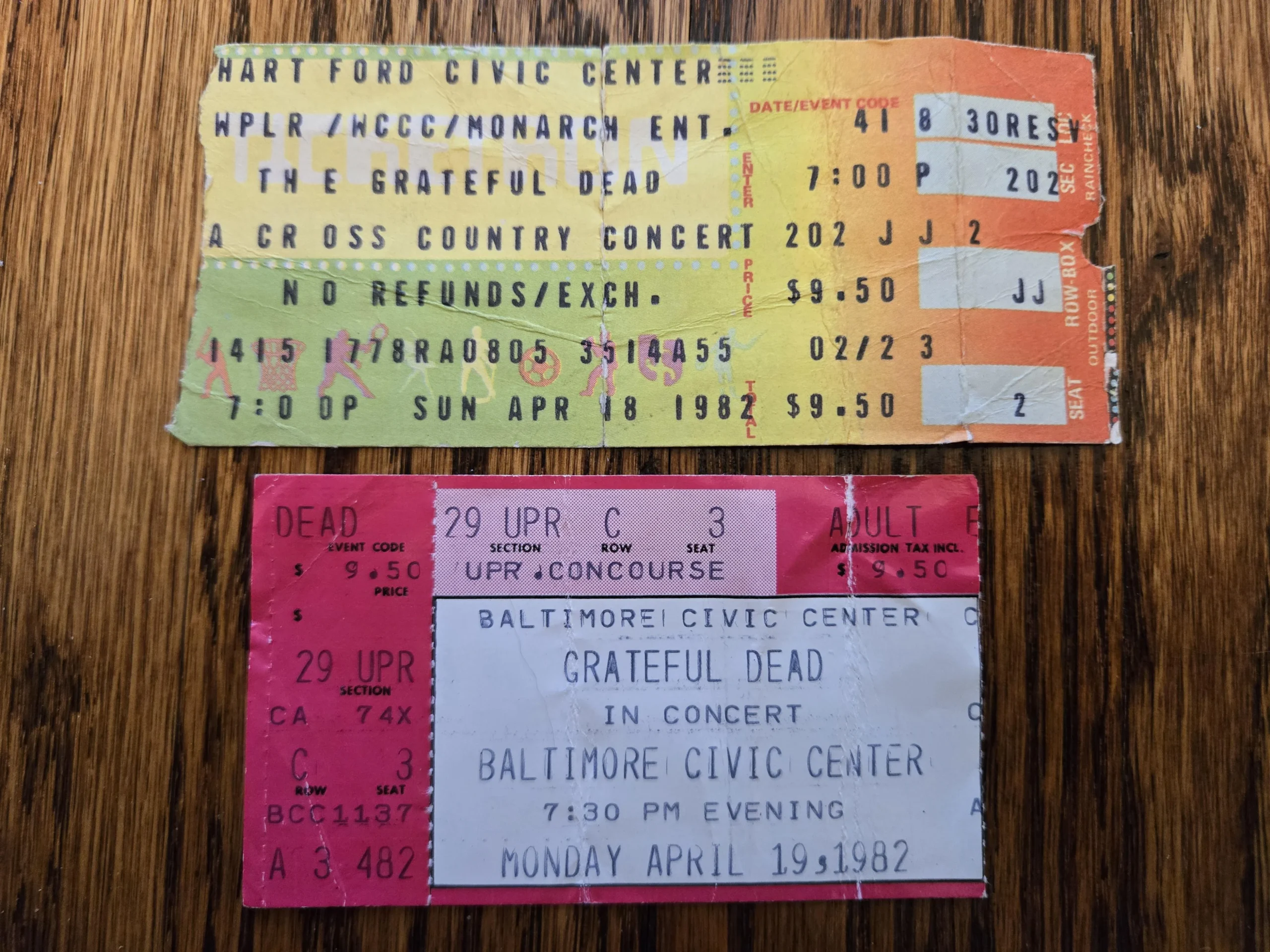
There are certain nights in Grateful Dead history that don’t just live in tape collections or setlist archives—they live in the body. You feel them. You remember where you stood, what it sounded like in the hallway before you even got inside, and how something shifted in the room that nobody could fully explain in the moment. April 18, 1982, at the Hartford Civic Center is one of those nights. It wasn’t just another stop on a spring tour that, in hindsight, was remarkably accessible and easy to follow—it was a night where the band leaned fully into atmosphere, into improvisation, into storytelling without a script, and into a kind of sonic theater that only they could deliver.
I know that because I was there.
I was young, moving through the building more than sitting in any one place, catching fragments of sound before the full picture came into focus. Hartford was one of those venues where, depending on where you were, the music didn’t immediately hit you the way it would once you got inside. There were doors, barriers—literal and figurative—that kept the sound contained. You had to chase it a little. And that’s exactly what we did.
At first, you could barely hear what was happening. Just a distant rumble. Then we moved along the side, pushing closer to where the energy was leaking out. That’s when things started to get strange. From a higher vantage point near the side of the stage, you could see movement that didn’t quite line up with a standard performance rhythm. It looked chaotic, loose, almost surreal. There was a sense—right or wrong at the time—that something different was happening onstage, something not entirely planned in the traditional sense. Back then, without phones, without instant information, you were left to interpret what you were seeing and hearing in real time.
And then it hit.
What unfolded during the second set—specifically after “Drums”—has since been etched into Deadhead lore as “Earthquake Space,” but in the moment, it wasn’t labeled, categorized, or understood. It was experienced. The band dropped into a low-frequency, destabilizing improvisation that felt less like music and more like an environmental event. Phil Lesh’s bass didn’t just anchor the sound—it detonated within it. Those signature “Phil bombs” weren’t accents; they were tectonic shifts. The building didn’t just resonate—it seemed to move.
Over that sonic landscape, Phil delivered something you almost never heard from him in that way: a spoken-word improvisation, part narration, part invocation. He pulled imagery from San Francisco’s Barbary Coast, referencing a time and place defined by chaos, excess, and ultimately, destruction. Then came the word that cut through everything—“Earthquake.” Repeated, emphasized, embodied. It wasn’t a lyric. It was a signal.
At the time, we didn’t have the context. No one was checking dates or pulling up historical references mid-set. You experienced it first and understood it later. It wasn’t until afterward—whether later that night or the next day—that it became clear: April 18 marked the anniversary of the 1906 San Francisco earthquake. What the band had tapped into wasn’t random. It was intentional in spirit, even if improvised in execution. They had aligned the performance with history, turning a jam segment into a kind of living, breathing commemoration.
That realization only deepens the impact of what happened in that room.
The second set itself was already structured for lift-off. “Cold Rain & Snow” opened with momentum, followed by a driving “Samson & Delilah” that brought the crowd fully into sync. “Ship of Fools” added emotional weight before the band transitioned into the expansive core of the set: “Playing in the Band” flowing into “Eyes of the World.” From there, the descent into “Drums” set the stage for what would become one of the most talked-about improvisational segments of that era.
And then came the rupture.
“Earthquake Space” wasn’t just a jam—it was a disruption of expectations. Rhythm dissolved. Structure disappeared. Sound became texture, pressure, movement. When the band finally steered out of that abyss and into “The Other One,” it felt less like a transition and more like a re-entry. The audience had been somewhere else entirely, and now they were being pulled back into a familiar gravitational field.
“Black Peter” and “Sugar Magnolia” brought the set to a close, but by then, the night had already cemented itself as something singular.
Looking back, what stands out isn’t just the performance itself, but how it fit into the broader arc of that tour. It was a run of shows that, for those of us following along, felt accessible, almost effortless to track. I made nearly every stop—missed just one—but Hartford was the one that lingered differently. Not because it was the biggest or the loudest, but because it caught you off guard. It asked more of you as a listener. It didn’t present itself neatly. You had to piece it together.
And now, years later, we have the opportunity to revisit that night in full, to experience it with the clarity of hindsight while still preserving the rawness of what it was. Playing this show in its entirety on its anniversary isn’t just a programming decision—it’s a recognition of what the Grateful Dead were capable of when they stepped beyond the expected and into something more immersive, more conceptual, more alive.
That’s exactly why this becomes an easy and essential selection for Don’s Pick.
Every Saturday night, Don’s Pick Radio Show brings that same spirit of curation and deep listening to the forefront. It’s not about random tracks or surface-level nostalgia—it’s about choosing moments that matter, performances that tell a story, and nights like April 18, 1982, that reward a full, uninterrupted listen. Hosted with the kind of insight and lived experience that only comes from being there, Don’s Pick continues to carve out a space where music isn’t just played—it’s understood, contextualized, and felt again.
This week, there’s no question. This is the show.
It captures the Grateful Dead at a point where risk and intuition were fully aligned. It documents a moment when improvisation crossed into narrative, when sound design became storytelling, and when a band used the anniversary of a historic event to create something that, in its own way, became history.
If you’ve heard it before, you already know. If you haven’t, there’s no better entry point than now.
Turn it up. Let it unfold. And remember—some nights weren’t just concerts.
They were events.