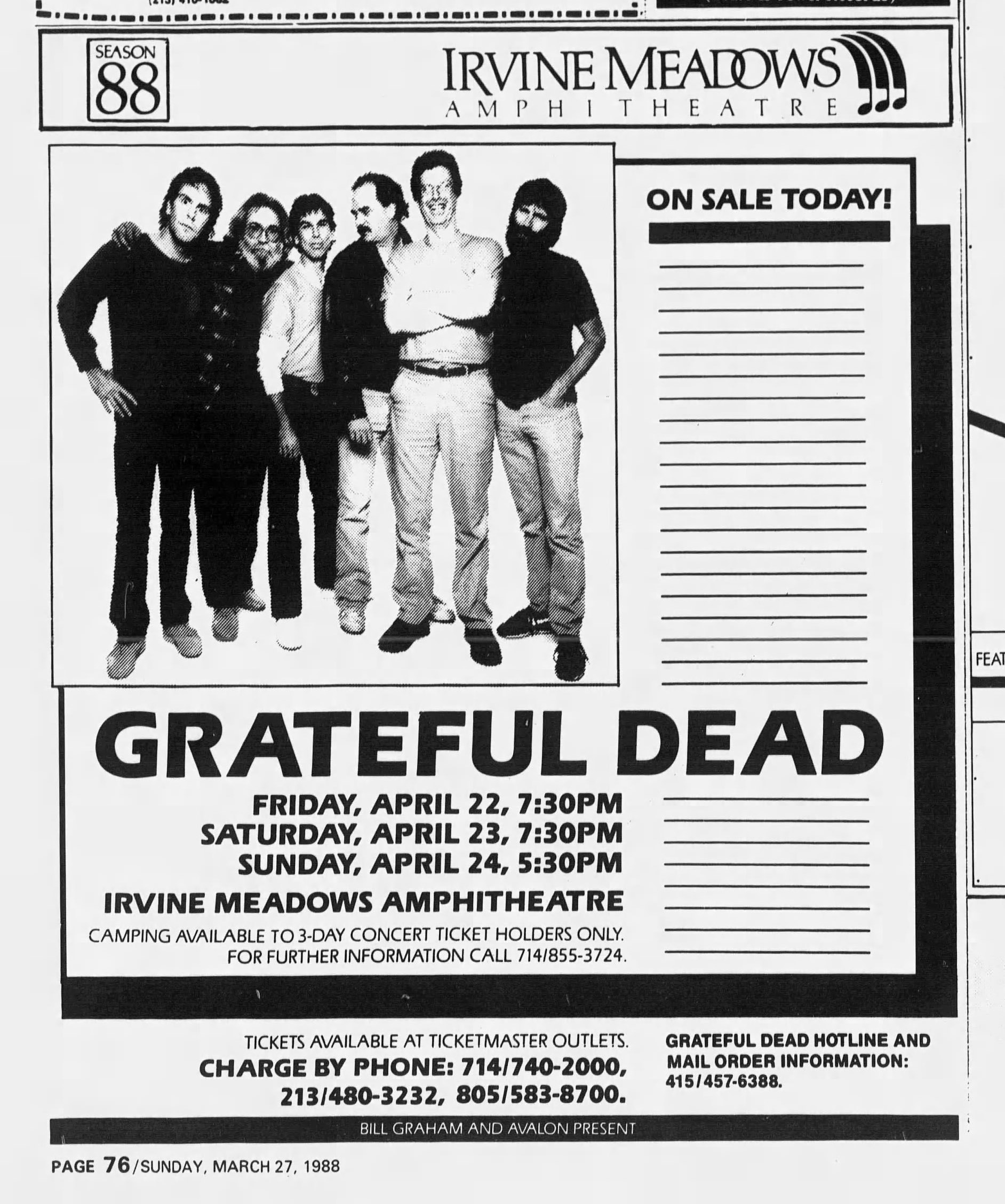
Grateful Dead’s April 23, 1988 Irvine Meadows is Don's Pick Tonight!
 DJ Don Edwards
The Night the Hills Sang Back: Reconstructing the Grateful Dead’s April 23, 1988 Irvine Meadows Broadcast
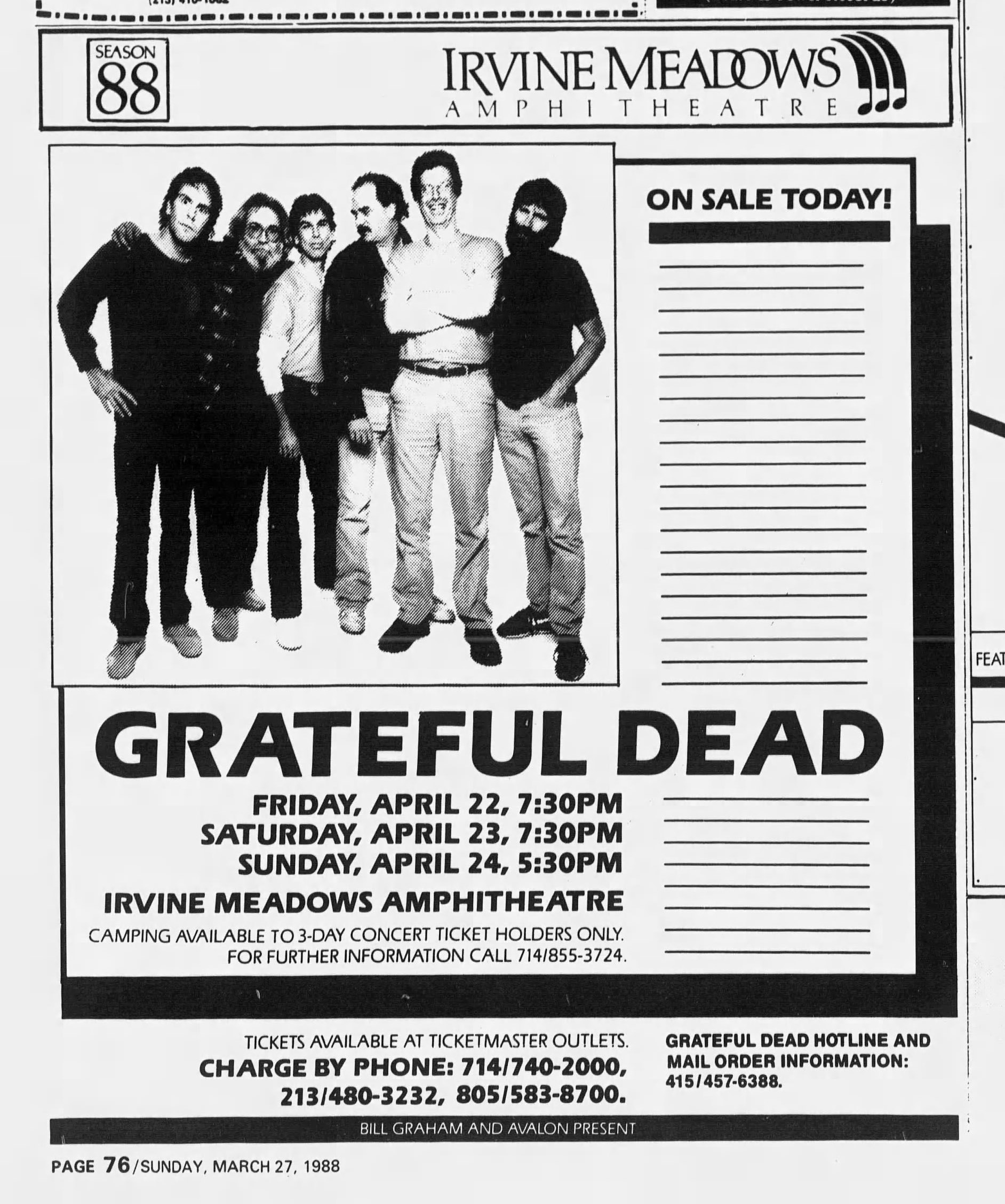
There are Grateful Dead shows that exist as entries in a setlist database, and then there are nights that take on a life of their own—passed hand to hand, tape to tape, memory to memory—until they become something closer to folklore than documentation. April 23, 1988, at Irvine Meadows Amphitheatre belongs firmly in that second category. It stands not just as the midpoint of a three-night Southern California stand, but as a fully realized statement of what the late-’80s Grateful Dead could be when the variables aligned: looseness without collapse, structure without rigidity, and a crowd-band feedback loop that felt almost liturgical in intensity.
Positioned deep into a revitalized era for the band, 1988 reflects a group that had recalibrated after the uncertainties of the mid-’80s. Jerry Garcia’s return to strength, the increasingly adventurous interplay between Brent Mydland’s keyboards and Bob Weir’s rhythmic architecture, and the ever-elastic foundation provided by Phil Lesh and the dual-drum engine of Mickey Hart and Bill Kreutzmann created a sonic environment where risk wasn’t just tolerated—it was expected. Irvine Meadows, with its open-air acoustics and hillside sprawl, became the ideal laboratory for that approach.
The night opens with “Hell in a Bucket,” not merely as a standard set-one ignition but as a declaration of intent. The tempo is assertive, the phrasing tight, and the band wastes no time establishing a conversational dynamic across the stage. “Cold Rain and Snow” follows with a slightly rough-edged urgency, Garcia leaning into the vocal phrasing with a sense of momentum that carries forward into one of the more distinctive early-set turns of the evening.
“Hey Pocky Way” arrives not as a novelty but as a groove-centric pivot, preceded by a playful and unexpected “Beer Barrel Polka” tuning tease—one of those fleeting, almost surreal moments that define Dead shows as much as the songs themselves. It’s a reminder that nothing is ever fully off the table. The band is listening, reacting, and willing to veer sideways if the moment calls for it. That sense of spontaneity continues through “West L.A. Fadeaway,” where the rhythmic pocket tightens and Mydland’s contributions begin to color the edges of the performance with a distinctly late-’80s texture.
A brief classical nod emerges in the form of a “Funiculì, Funiculà” tease—another fragment, another signal that the band is in a playful, exploratory headspace. From there, the traditional pairing of “Me and My Uncle” into “Big River” provides a roots-driven counterbalance, grounding the set before it transitions into what many who were there still describe as the emotional core of the night.
“To Lay Me Down” closes the first set, and it does so with a gravity that transcends its placement. The performance carries a near-reverent stillness, with Garcia delivering one of those readings that seems to suspend time rather than measure it. Audience accounts consistently return to the same language: a “religious feel,” a shared quiet that spreads outward from the stage and settles over the amphitheatre. In a catalog built on movement and improvisation, moments of stillness like this are what give the larger arc its depth.
The set doesn’t end there, technically—“Cassidy” and “Don’t Ease Me In” follow—but the emotional punctuation has already been placed. What remains is momentum, and that momentum carries directly into a second set that leans heavily into the band’s improvisational core.
“Playing in the Band” opens the second frame as a gateway rather than a destination, dissolving into “Crazy Fingers” with a fluidity that underscores just how interconnected the band’s repertoire had become. This is where the Dead’s architecture reveals itself most clearly: songs are not endpoints, but nodes in a larger network of musical ideas. “Uncle John’s Band” emerges from that network with a sense of inevitability, its communal refrain reinforcing the collective energy that had been building since the first notes of the night.
“Drums” and “Space” function, as always, as both deconstruction and reset—an abstract interlude where rhythm and texture replace melody and form. But on this night, they feel less like a detour and more like a necessary recalibration, clearing the sonic palette for a closing sequence that balances release with reflection.
“Going Down the Road Feeling Bad” injects motion back into the set, followed by a muscular “I Need a Miracle” that reasserts the band’s ability to drive a straight-ahead rock groove when needed. The transition into “Dear Mr. Fantasy,” complete with its “Hey Jude” coda, expands the emotional range once again, bridging classic rock lineage with the Dead’s own interpretive voice. By the time “Stella Blue” arrives, the performance has entered its final phase—a winding down that doesn’t so much diminish the energy as redirect it inward.
“Turn On Your Love Light” closes the second set with a return to exuberance, a reminder that even after extended exploration, the band could still lock into a communal groove that felt immediate and unfiltered. The encore, “Knockin’ on Heaven’s Door,” lands with a sense of closure that feels earned rather than obligatory—a final statement that resonates beyond its runtime.
Yet part of what cements this show in the mythology of the Dead isn’t confined to the stage. Irvine Meadows offered its own parallel experience for those without tickets: the hillside beyond the venue, adjacent to a military installation, became an unofficial extension of the audience. Fans would make the climb, navigating both terrain and security, to catch glimpses and fragments of the performance from beyond the fence. It’s a detail that encapsulates the broader Dead experience—music that couldn’t be fully contained by walls, tickets, or formal boundaries.
For listeners revisiting this show today, whether through archival recordings or reconstructed broadcasts, the April 23, 1988 performance stands as a case study in balance. It captures a band that understood its own elasticity, that could move from playful teases to profound stillness without losing coherence, and that treated each set not as a checklist but as a living narrative.
That narrative continues to be preserved and reinterpreted through programming like the On the Bus Radio Show, where nights like Irvine Meadows are not simply replayed but reframed—contextualized within the broader arc of the Grateful Dead’s live evolution. It is in that ongoing circulation, that constant return to the source material, that the true legacy of performances like this is maintained. Not as static artifacts, but as living documents—open to rediscovery, reinterpretation, and, most importantly, continued listening.