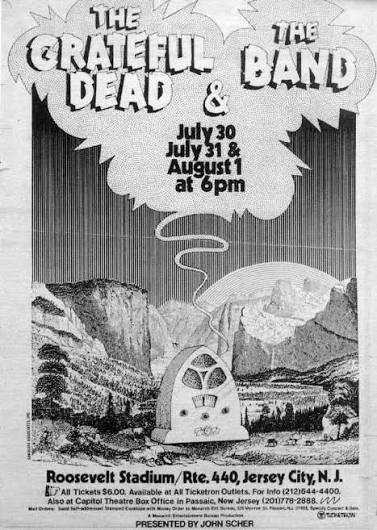
Don's Pick is Jerry Garcia's 31st Birthday, Roosevelt Stadium in Jersey City
 DJ Don Edwards
Jerry Garcia’s 31st Birthday, The Night Roosevelt Stadium Became Grateful Dead History, Looking Back at the Legendary August 1, 1973 Concert in Jersey City. Some concerts become memorable because of the songs that were played. Others become legendary because of where they happened or who happened to be on stage. Then there are the rare performances that transcend both, evolving into something far larger than a single evening of music. The Grateful Dead’s appearance at Roosevelt Stadium in Jersey City, New Jersey, on August 1, 1973, belongs firmly in that final category. More than five decades later, the performance continues to occupy a place among the most celebrated concerts in the band’s remarkable touring history, remembered not only as Jerry Garcia’s thirty first birthday celebration but also as one of the defining musical statements of the Grateful Dead’s extraordinary 1973 tour.
Within the expansive universe of Grateful Dead live recordings, where virtually every performance has been documented, debated, traded, and analyzed by generations of devoted listeners, Roosevelt Stadium stands apart. It represents the moment when an already adventurous band reached another level of collective improvisation, confidence, and musical communication. The concert remains one of the finest examples of why the Grateful Dead became one of the greatest live acts in American music, creating performances that could never be fully replicated and that rewarded audiences willing to follow wherever the music happened to lead.
The summer of 1973 found the Grateful Dead performing at an extraordinary level. The group had entered one of its most creatively fertile periods, balancing sophisticated songwriting with fearless improvisation while expanding its musical vocabulary well beyond the boundaries of rock and roll. Jazz influences, folk traditions, blues, country music, and exploratory psychedelic passages all existed comfortably within the same performance, often within the same song. Rather than relying on rehearsed structures, the band embraced spontaneity, allowing each concert to become a unique conversation among six musicians who had developed an almost telepathic understanding of one another.
Only days before arriving in Jersey City, the Grateful Dead had participated in one of the most famous gatherings in rock history, the Summer Jam at Watkins Glen in upstate New York. That event drew one of the largest concert audiences ever assembled and further elevated the band’s national profile. Instead of slowing down after such a historic appearance, they carried that creative momentum directly into Roosevelt Stadium, delivering a performance that many longtime listeners consider even more artistically satisfying.
Roosevelt Stadium itself had already established an important place in New Jersey’s musical history. Long before modern amphitheaters and entertainment complexes reshaped the live concert landscape, the Jersey City venue welcomed many of the era’s most influential performers. Its open air setting, energetic crowds, and working class atmosphere created an ideal environment for the Grateful Dead, whose relationship with audiences had always been built on shared experiences rather than conventional performances. For one unforgettable evening, Roosevelt Stadium became the center of the improvisational music world.
The evening featured an exceptional co headlining bill with The Band, another group whose influence on American music remains immeasurable. Their appearance alongside the Grateful Dead brought together two of the most respected ensembles of the era, each approaching rock music from different perspectives while sharing a deep appreciation for American musical traditions. The Band delivered a powerful performance of their own before the Grateful Dead took the stage, creating an atmosphere that steadily built throughout the night. As the concert progressed, members of The Band eventually joined the Grateful Dead onstage, adding another memorable chapter to an evening already overflowing with historic moments.
The first set immediately demonstrated that the band had arrived in outstanding form. Performances of “Sugaree,” “Bird Song,” and “Stella Blue” showcased the remarkable maturity the Grateful Dead had developed by 1973. Garcia’s guitar tone possessed a lyrical elegance that floated effortlessly above the band’s intricate rhythmic foundation, while Keith Godchaux’s piano continued to add harmonic sophistication that defined this period of the group’s evolution. Every song displayed remarkable patience, with the musicians allowing ideas to develop naturally instead of rushing toward familiar destinations.
As exceptional as the opening set proved to be, it serves today primarily as the introduction to one of the most celebrated continuous sequences ever performed by the Grateful Dead. The second set evolved into a breathtaking hour of uninterrupted musical exploration that continues to be studied, celebrated, and revisited by Deadheads around the world.
The journey began with “Dark Star,” already regarded as the band’s ultimate improvisational canvas. During this performance, the Grateful Dead transformed the composition into an expansive exploration lasting approximately twenty five minutes. Rather than following predictable patterns, the musicians ventured through constantly shifting musical landscapes, incorporating jazz inspired interplay, atmospheric textures, subtle rhythmic changes, and moments of near complete abstraction. Garcia’s melodic ideas seemed limitless, Phil Lesh’s bass lines moved freely through the harmonic framework, Bill Kreutzmann’s drumming remained endlessly inventive, and the collective listening between every member of the group reached extraordinary levels.
What happened next remains one of the most talked about transitions in Grateful Dead history. Instead of returning to the familiar conclusion of “Dark Star,” Bob Weir unexpectedly steered the band into Marty Robbins’ western classic “El Paso.” On paper, the transition appears almost impossible. In performance, however, it unfolded with remarkable confidence and precision. The dramatic shift from deep psychedelic improvisation into traditional cowboy storytelling captured everything that made the Grateful Dead unique. Few bands possessed both the technical ability and artistic courage to connect such radically different musical worlds without sacrificing momentum.
The stylistic surprise only increased the anticipation for what followed. Emerging seamlessly from “El Paso,” the band launched into an exhilarating early version of “Eyes of the World.” Still relatively new to the repertoire during 1973, the composition displayed tremendous energy and optimism. Garcia’s lead playing throughout the performance has become especially admired among collectors and historians for its remarkable fluidity, melodic invention, and seemingly effortless creativity. The rhythmic interplay between Lesh and Kreutzmann provided an elastic foundation that allowed every improvisational phrase to unfold naturally while maintaining relentless forward motion.
As the musical journey approached its conclusion, the Grateful Dead transitioned into “Morning Dew,” delivering one of the evening’s most emotionally powerful performances. Long regarded as one of the band’s most dramatic compositions, the song built patiently toward an unforgettable climax filled with emotional intensity and soaring guitar work. Garcia’s closing solo remains one of the defining moments of the entire concert, balancing technical brilliance with genuine emotional expression. Together, the uninterrupted sequence of “Dark Star,” “El Paso,” “Eyes of the World,” and “Morning Dew” forms more than an hour of continuous music that many fans consider among the greatest sustained performances of the Grateful Dead’s entire career.
The concert also carried personal significance as Jerry Garcia celebrated his thirty first birthday. According to those in attendance, Roosevelt Stadium erupted in celebration as fireworks illuminated the Jersey City skyline during the performance, creating a memorable visual backdrop for an already unforgettable evening. The atmosphere reflected the deep connection between the band and its audience, a relationship built through years of constant touring and mutual trust. Rather than feeling like spectators, fans became participants in a communal celebration that stretched late into the night.
The performance concluded with the joyful momentum of “Goin’ Down the Road Feeling Bad” before the band returned for a spirited encore of “One More Saturday Night.” Although technically not a Saturday evening, the choice perfectly captured the celebratory mood surrounding Garcia’s birthday and brought the historic performance to an energetic conclusion.
Over the decades, the Roosevelt Stadium concert has only grown in stature. It remains one of the most frequently recommended recordings for anyone seeking to understand why the Grateful Dead developed such an enduring reputation as a live band. Tape collectors have long regarded it as essential listening, while musicians continue to study its improvisational depth and remarkable group communication. Tribute ensembles, most notably Dark Star Orchestra, have recreated the complete performance in recognition of its importance within Grateful Dead history, allowing new generations of listeners to experience one of the band’s greatest nights as faithfully as possible.
Beyond its musical accomplishments, the August 1, 1973 performance also occupies an important place in New Jersey’s cultural history. Roosevelt Stadium may no longer stand, but its legacy remains inseparable from the remarkable concerts that unfolded within its walls. Few venues can claim to have hosted an evening that continues to inspire discussion, scholarship, and celebration more than fifty years after the final encore.
For Grateful Dead fans, August 1, 1973 represents far more than another stop on a summer tour. It captures a band operating at the height of its creative powers, musicians completely committed to exploration, and an audience willing to embrace every unexpected turn. It stands as a reminder that the greatest live performances cannot be manufactured or repeated. They occur when preparation, inspiration, chemistry, and circumstance converge for a single extraordinary night.
Jerry Garcia’s thirty first birthday celebration in Jersey City remains one of those nights. More than half a century later, it continues to define what made the Grateful Dead unlike any other band in American music, proving that the most enduring concerts are not simply remembered. They become part of musical history.