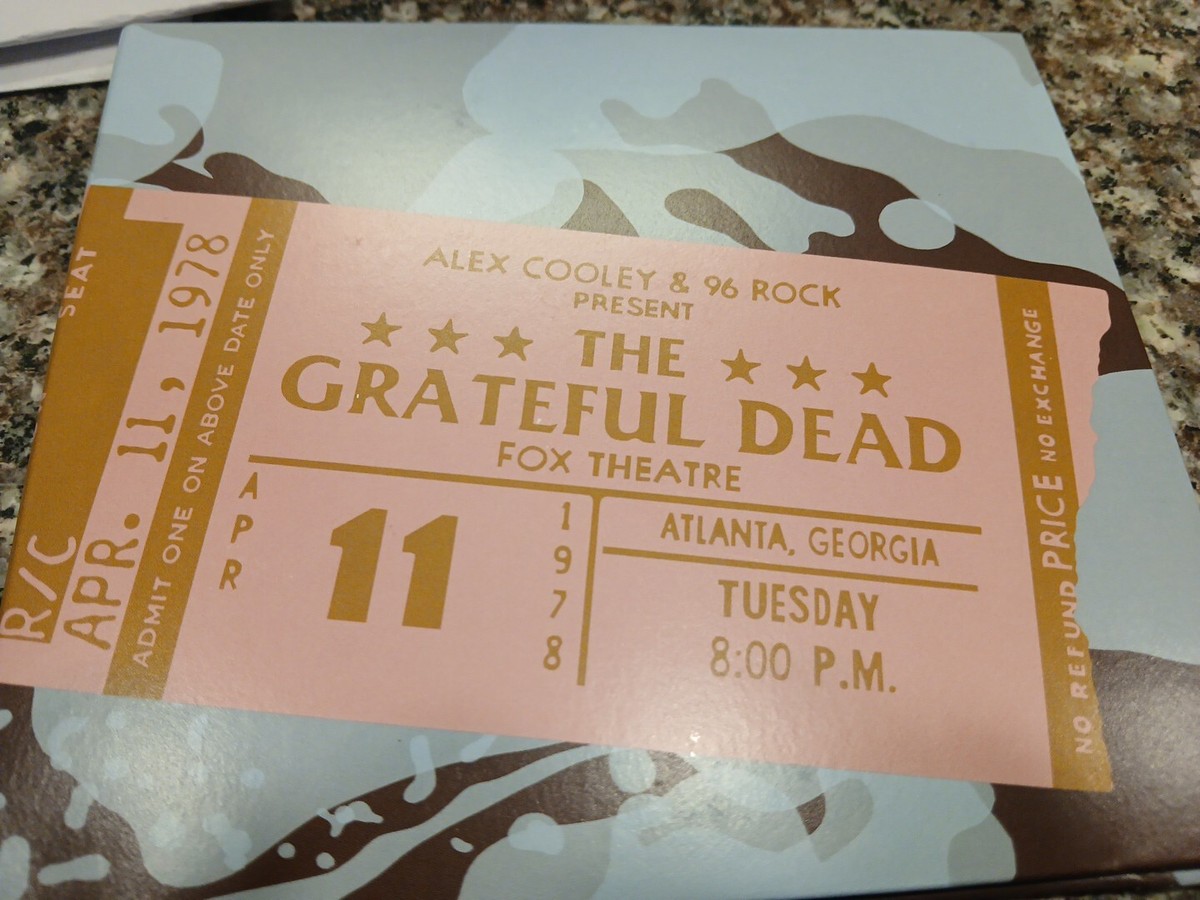
The Grateful Dead Live Presents Atlanta ’78 Revisited on Don's Pick Tonight!
 DJ Don Edwards
A Defining Night of Fire, Freedom, and the Sound That Shaped an Era – There are nights in the Grateful Dead’s long, unpredictable road history that rise above the rest—not simply because of what was played, but because of how it was played, how it felt in the room, and how it continues to resonate decades later. April 11, 1978, at the Fox Theatre in Atlanta, Georgia, stands firmly in that category. It is a performance that captures the band at full throttle—loose yet locked in, exploratory yet focused, and operating at a level of intuitive communication that few live acts in any genre have ever matched. Now preserved in pristine clarity as part of the expansive Friend of the Devils: April 1978 collection, this show has evolved from underground tape-trader legend to essential listening for anyone serious about understanding the Grateful Dead’s live legacy.
Spring 1978 was not just another tour—it was a transitional moment. The band was refining the second-set architecture that would become a defining feature of their concerts for years to come. The emergence and normalization of the “Drums” and “Space” segments signaled a deeper commitment to improvisation as a structural pillar, not just a spontaneous detour. These were not interludes—they were statements. And in Atlanta, that philosophy comes alive with urgency and purpose.
From the opening notes, the energy is unmistakable. The first set launches with a seamless “Bertha” into “Good Lovin’,” a pairing that immediately establishes momentum and tone. Jerry Garcia’s guitar work is sharp and expressive, while his vocals carry a clarity and conviction that cut through the mix. This is not a band easing into the night—this is a band arriving fully formed, already in motion. As the set unfolds, “Tennessee Jed” becomes a focal point, with Garcia leaning into its narrative weight, stretching phrases and bending notes in a way that feels both deliberate and free. “Deal” follows as a high watermark, its escalating solo section building tension and release in classic Dead fashion—controlled chaos with a melodic center.
What sets this performance apart, however, is not just the playing—it’s the sound. Captured by the legendary Betty Cantor-Jackson, this recording is part of the revered “Betty Boards,” known for their exceptional fidelity and balance. Every instrument is present, every nuance preserved. Phil Lesh’s bass lines are not just audible—they’re foundational, weaving counterpoint beneath Garcia’s leads. Bill Kreutzmann and Mickey Hart drive the rhythm with a dual-drummer approach that is both muscular and elastic. Keith Godchaux’s piano adds texture and harmonic depth, while Donna Jean Godchaux’s vocals—often a point of debate among fans—are notably cohesive and well-integrated throughout the performance, particularly on this night.
The second set is where the show transcends. “Samson and Delilah” arrives with gospel-infused power, setting the stage for a sequence that would become one of the band’s most iconic: “Scarlet Begonias” into “Fire on the Mountain.” In 1978, this pairing was still relatively new, still evolving, and here it feels alive with possibility. The transition is fluid, almost conversational, as the band shifts from the rhythmic bounce of “Scarlet” into the hypnotic groove of “Fire.” Garcia’s phrasing is exploratory, dancing around the beat, while the rhythm section locks into a pulse that feels both grounded and expansive.
Then comes the pivot—the descent into “Drums” and “Space.” This is not a break; it’s a transformation. The structure dissolves, replaced by texture, tone, and collective instinct. It is here that the Grateful Dead’s commitment to improvisation becomes most evident. The band is not playing songs—they are creating soundscapes in real time, navigating without a map. Out of this abstract terrain emerges a rare gem: “Iko Iko,” appearing in a late-70s context that gives it a different flavor—less New Orleans street party, more psychedelic ritual. The transition into “Sugar Magnolia” brings the energy back into focus, culminating in a celebratory release that feels earned and organic.
The encore, a blistering take on Chuck Berry’s “Johnny B. Goode,” serves as both homage and exclamation point. It’s fast, tight, and executed with a sense of joy that underscores the entire evening. This is a band that knows exactly what it’s doing, even when it appears to be flying by instinct alone.
What makes this Atlanta performance endure is not just its setlist or its sound quality—it’s the chemistry. There is a palpable sense that the band is fully engaged, listening to one another, pushing and pulling in real time. It’s not perfection in the traditional sense; it’s something more compelling. It’s the kind of “perfectly imperfect” interplay that defines the Grateful Dead at their best—raw, responsive, and alive.
This is precisely the kind of performance that finds new life on Don’s Pick, the Saturday night radio experience built for listeners who understand that music is not just something you hear—it’s something you inhabit. Curated with intention and delivered with deep knowledge, Don’s Pick brings nights like April 11, 1978 back into circulation, not as nostalgia, but as living documents. Each broadcast is a journey through sound, guided by a host who treats the music with the respect and context it deserves. For fans across all age groups, it’s an invitation to rediscover what made these performances matter—and why they still do.
In a digital landscape saturated with content, what cuts through is authenticity. The Grateful Dead never chased perfection—they chased connection. And on that spring night in Atlanta, they found it. Not in a single song, not in a single solo, but in the totality of the experience. It’s a show that doesn’t just reward repeated listening—it demands it. Every pass reveals something new, some subtle interplay or overlooked detail that deepens the appreciation.
For those building a serious understanding of the Grateful Dead’s live canon, this performance is not optional—it’s foundational. It captures a band in transition, in evolution, and in full command of its identity. And through platforms like Don’s Pick, it continues to reach new ears, proving that great music doesn’t age—it expands.