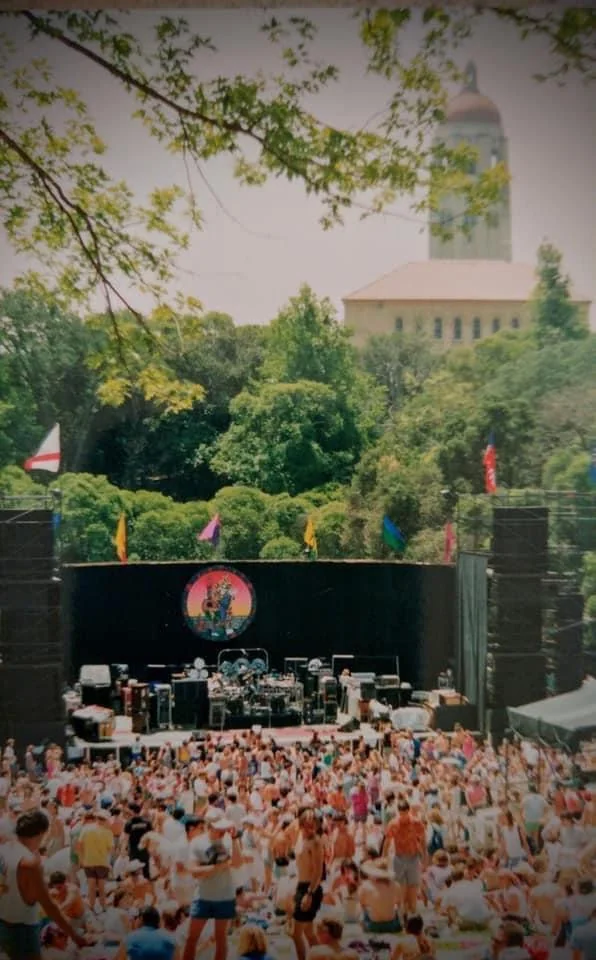
May 6, 1989 at the Frost Amphitheater is Don's Pick This Week!
 DJ Don Edwards
May 6, 1989 at Frost Amphitheater: The Grateful Dead’s Kentucky Derby Day Performance That Closed a Chapter with Precision and Power
There are nights in the long and ever-evolving history of the Grateful Dead where context, performance, and timing align to create something far more meaningful than a single show. May 6, 1989, at the Frost Amphitheater on the campus of Stanford University in Palo Alto stands as one of those nights—a performance that not only delivered musically, but also symbolized the closing phase of the band’s relationship with one of its most intimate and historically significant venues.
By the late 1980s, the Grateful Dead had reached a level of demand that made spaces like the Frost Amphitheater increasingly difficult to sustain within their touring model. The venue’s 7,000-seat capacity, once ideal for the band’s communal and exploratory live experience, had become too limited for an audience that now stretched far beyond what the space could accommodate. The May 6 performance, staged as a benefit for the Rex Foundation and broadcast over Stanford’s KZSU radio station, carried an unspoken awareness of that transition. It was not framed as a farewell in the traditional sense, but it functioned as one nonetheless.

The night opened with “Jack Straw,” a fitting choice that immediately established both narrative momentum and tonal balance. From there, the first set unfolded with a deliberate pacing that showcased the band’s late-era cohesion. “Peggy-O” provided a reflective counterpoint, while “Walkin’ Blues” and “They Love Each Other” reinforced the rhythmic versatility that had become a hallmark of this period. What set this first set apart, however, was not just its consistency, but its sense of occasion.
Falling on Kentucky Derby Day, the band leaned into tradition with a well-timed performance of “The Race Is On,” a detail that reflected their instinct for connecting external cultural moments with internal setlist decisions. It was a subtle but effective nod that grounded the performance in a specific moment while maintaining the fluidity of the overall show. The set continued to build through “West L.A. Fadeaway,” “Just a Little Light,” and “Queen Jane Approximately,” each contributing to a sense of steady progression rather than abrupt contrast.
The defining moment of the first set arrived at its close, with the pairing of “China Cat Sunflower” into “I Know You Rider.” While this sequence is part of the band’s established repertoire, its placement here—closing the set rather than appearing mid-flow—gave it additional weight. The transition was executed with clarity and purpose, capturing the interplay between melody and improvisation that defined the Grateful Dead’s live identity. It was both a nod to tradition and a statement of intent, signaling that this performance would carry a deeper resonance.
The second set opened with “Let the Good Times Roll,” immediately shifting the energy toward a more expansive and groove-oriented space. “Hey Pocky Way” and “Samson and Delilah” reinforced that momentum, creating a rhythmic foundation that allowed the band to stretch without losing structural cohesion. “Ship of Fools” introduced a more introspective tone, setting the stage for the central improvisational sequence that would define the remainder of the performance.
“Playing in the Band” served as the gateway into that exploration, evolving naturally into “Eyes of the World” before dissolving into the abstract terrain of “Drums” and “Space.” This sequence, a cornerstone of the band’s second-set architecture, functioned here with particular effectiveness, allowing the musicians to navigate freely between structure and abstraction. What followed was a carefully constructed return to form, as “I Will Take You Home” and “The Wheel” reintroduced melodic clarity before the energy surged again through “I Need a Miracle” and “Wharf Rat.”
The closing stretch of the second set—“Around and Around” into “Not Fade Away”—brought the performance back into a space of communal release, reinforcing the cyclical nature of the Grateful Dead’s live experience. By the time the band returned for the encore, the arc of the evening had been fully realized. “Black Muddy River,” delivered with restraint and emotional depth, provided a final statement that felt both grounded and reflective, a closing moment that resonated beyond the immediate performance.
What elevates the May 6, 1989 show beyond its individual components is the way it captures the Grateful Dead at a point of transition without sacrificing any of the elements that defined their identity. The intimacy of the Frost Amphitheater remains present in the recording and the performance itself, even as the band’s trajectory was clearly moving toward larger venues and broader audiences. The broadcast over KZSU ensured that the experience extended beyond those in attendance, preserving the performance in real time and embedding it within the broader listening culture that has always surrounded the Dead.
That culture of listening, revisiting, and reinterpreting live material continues to find new expression through modern platforms such as Don’s Pick Radio Show. Airing every Saturday night, Don’s Pick operates with the same curatorial precision that has long defined how Grateful Dead performances are experienced by dedicated listeners. Each episode is built around a carefully selected sequence of tracks, designed to highlight not only individual performances, but the relationships between them—the way songs evolve, interact, and take on new meaning across different contexts.
Within that framework, a performance like May 6, 1989, becomes more than a historical reference point. It becomes a living document, one that can be revisited, analyzed, and appreciated in new ways through curated broadcast experiences. Don’s Pick Radio Show reinforces this ongoing engagement, presenting music not as static content, but as an evolving conversation that continues to unfold with each listen.
In the broader scope of the Grateful Dead’s legacy, the May 6, 1989 performance at Frost Amphitheater stands as a clear and definitive moment—one that captures the band’s ability to balance tradition with transition, structure with improvisation, and intimacy with expansion. It is a show that reflects not only where the band had been, but where it was going, all while remaining firmly grounded in the principles that made their live performances singular.
Decades later, that balance remains intact. Through archival recordings, curated radio programming, and the continued dedication of those who engage deeply with this music, the performance endures not as a closed chapter, but as an active and essential part of a legacy that continues to evolve.