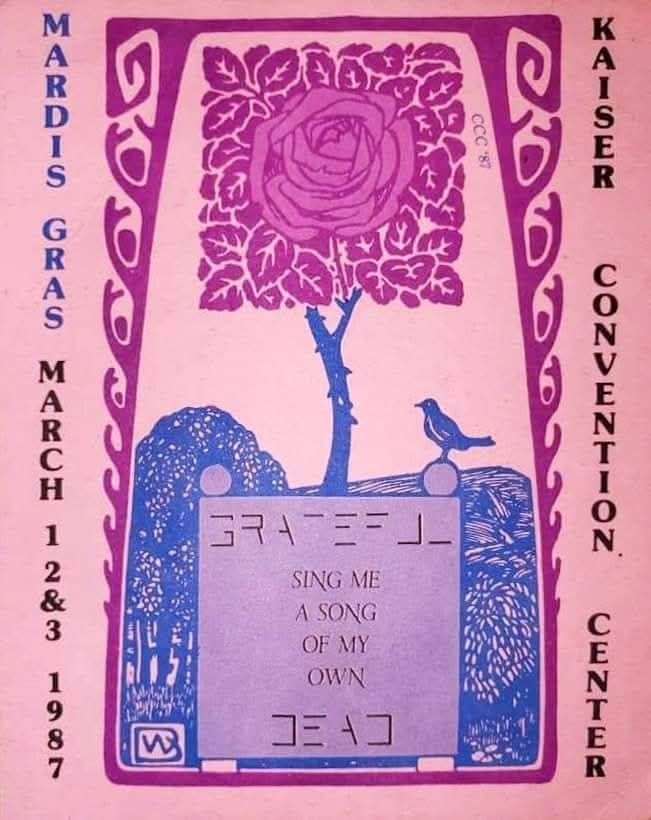
Don's Pick: The Grateful Dead Live: March 1, 1987 — Oakland’s Overlooked Gem and the Sound of a Band Reborn
 DJ Don Edwards
On March 1, 1987, at the Henry J. Kaiser Convention Center in Oakland, Grateful Dead stepped onto the stage to open a three-night run that would quietly become one of the most compelling early statements of their late-era resurgence.
It was more than just another Bay Area show. It was the first full year back after Jerry Garcia’s 1986 health crisis — and the band sounded not cautious, not tentative, but revitalized.
For serious Deadheads and live-music historians alike, this performance stands as an “overlooked gem” of 1987 — a show that balances emotional catharsis, tight ensemble interplay, new material from the In the Dark sessions, and the kind of exploratory improvisation that defined the Grateful Dead’s touring mythology.
This is the definitive breakdown.
Context: 1987 and the Dead’s Reawakening
By early 1987, the Grateful Dead were entering a pivotal phase. Garcia’s recovery had become a rallying point. Fans weren’t just attending concerts — they were celebrating survival.
The Kaiser run in Oakland represented:
-
The band’s first full touring year post-recovery
-
The testing ground for new songs
-
A reaffirmation of community within the Bay Area stronghold
-
Renewed energy in performance tempo and cohesion
There was gratitude in the room. There was relief. But above all, there was momentum.
The Complete Setlist Breakdown
This show is remarkable for its structural intelligence — alternating roots Americana, blues workouts, new-era songwriting, and expansive second-set improvisation.
Set One
Touch of Grey > Little Red Rooster
Peggy-O
Me and My Uncle > Mexicali Blues
When Push Comes to Shove
It’s All Over Now
Row Jimmy > Let It Grow
Opening with “Touch of Grey” was not subtle symbolism. It was a statement. The song — still months away from becoming a Top 10 hit — functioned as an anthem of resilience. Garcia’s vocal delivery carried a sense of shared triumph.
“Little Red Rooster” grounded the room in blues tradition, while “Peggy-O” showcased the Dead’s ability to reinterpret folk balladry with emotional clarity.
The cowboy pairing of “Me and My Uncle” into “Mexicali Blues” provided rhythmic snap before “When Push Comes to Shove” and “It’s All Over Now” kept the mid-set dynamic fluid.
But the true pivot point was “Row Jimmy” flowing into “Let It Grow.” The latter’s crescendo demonstrated a band fully locked in — layered guitars, dynamic drumming from Bill Kreutzmann and Mickey Hart, and melodic interplay from Bob Weir and Brent Mydland.
The first set closed not with exhaustion, but lift.
Set Two
Hell in a Bucket > Scarlet Begonias > Fire on the Mountain
Samson and Delilah
Black Muddy River
He’s Gone > Drums > Space > The Other One > Black Peter > Around and Around > Good Lovin’
If Set One was affirmation, Set Two was ignition.
“Hell in a Bucket” opened with swagger, quickly dissolving into one of the Dead’s most beloved transitions: “Scarlet Begonias” into “Fire on the Mountain.” The jam breathed. It didn’t rush. Garcia’s leads danced rather than sprinted.
The momentum rolled through “Samson and Delilah” before settling into “Black Muddy River,” a relatively new ballad at the time. Its placement mid-set allowed the emotional register to deepen — reflective, present, vulnerable.
From there, the show entered exploratory territory.
“He’s Gone” provided thematic weight before the rhythmic abstraction of “Drums” and “Space” — segments that embodied the Dead’s refusal to be confined by conventional structure.
Out of the sonic nebula emerged “The Other One” — powerful, declarative, and muscular. Followed by a soulful “Black Peter,” the emotional arc swung from cosmic to intimate.
The closing charge of “Around and Around” and “Good Lovin’” re-centered the audience in celebratory release.
Encore
Don’t Ease Me In
Simple. Joyful. Direct. A nod to the band’s jug-band roots and a reminder that despite experimentation and scale, the Dead were always anchored in American musical tradition.
Why March 1, 1987 Still Resonates
1. Touch of Grey as Cultural Signal
The opener foreshadowed the mainstream breakthrough of In the Dark later that year. Hearing it in this context feels intimate — before MTV exposure, before chart success.
2. Scarlet > Fire Momentum
The second-set launch remains one of the most balanced transitions of the late ’80s era — energized but controlled.
3. Black Muddy River’s Emotional Weight
Still relatively new in 1987, the song carried an immediacy that later versions would refine but rarely surpass in raw presence.
4. Drums > Space Evolution
By 1987, these segments were immersive rather than indulgent — dynamic, rhythmic, and leading purposefully into “The Other One.”
5. Soundboard Quality
Recordings circulating among collectors highlight remarkable clarity. The mix captures the band’s relaxed yet focused precision.
The Atmosphere: Tribes Together Again
Although the famed Chinese New Year celebrations had taken place a month earlier at the San Francisco Civic Center, the March Kaiser run maintained that communal electricity.
Fans describe the night as:
-
Warm but intense
-
Focused without tension
-
Confident without overstatement
-
A celebration of survival
This was not nostalgia. It was renewal.
The Grateful Dead Live Legacy in 1987
By March 1987, the Dead were:
-
Reasserting themselves creatively
-
Testing material that would define a commercial peak
-
Demonstrating resilience
-
Deepening the improvisational vocabulary of their late era
The Oakland run captures a band neither clinging to the past nor chasing the mainstream — but inhabiting a moment of equilibrium.
Why This Show Matters for Modern Listeners
In today’s streaming environment, live albums often feel curated and polished. The Grateful Dead’s 1987 performances remind us that live music is a living organism.
March 1, 1987 offers:
-
Narrative arc
-
Emotional pacing
-
Sonic experimentation
-
Communal release
-
Historic significance
For collectors and new fans alike, it represents a gateway into the Dead’s resilient late-’80s renaissance.
Don’s Pick Radio Show: Where the Archive Lives On
Moments like March 1, 1987 are exactly why Don’s Pick Radio Show continues to resonate with serious music listeners.
Don’s Pick is a highly anticipated Saturday night broadcast built around carefully curated selections from across the musical spectrum. Hosted by Don — knowledgeable, passionate, and deeply attuned to the nuances of live performance — each episode celebrates the expansive, eclectic power of music history.
When a show like the Kaiser ’87 opener surfaces on Don’s Pick, it isn’t nostalgia. It’s contextual storytelling. It’s musical advocacy. It’s preservation through broadcast.
The Grateful Dead’s live catalog thrives in environments where curation matters — and Don’s Pick embodies that philosophy.
The Enduring Power of the Live Experience
The March 1, 1987 performance at the Henry J. Kaiser Convention Center stands not as a blockbuster headline show, but as something arguably more meaningful:
A band restored.
A community reunited.
A catalog evolving in real time.
For those who were there, it was celebration.
For those discovering it now, it is documentation of rebirth.
And for anyone serious about understanding the Grateful Dead’s live legacy, Oakland ’87 is not optional listening — it is essential.