
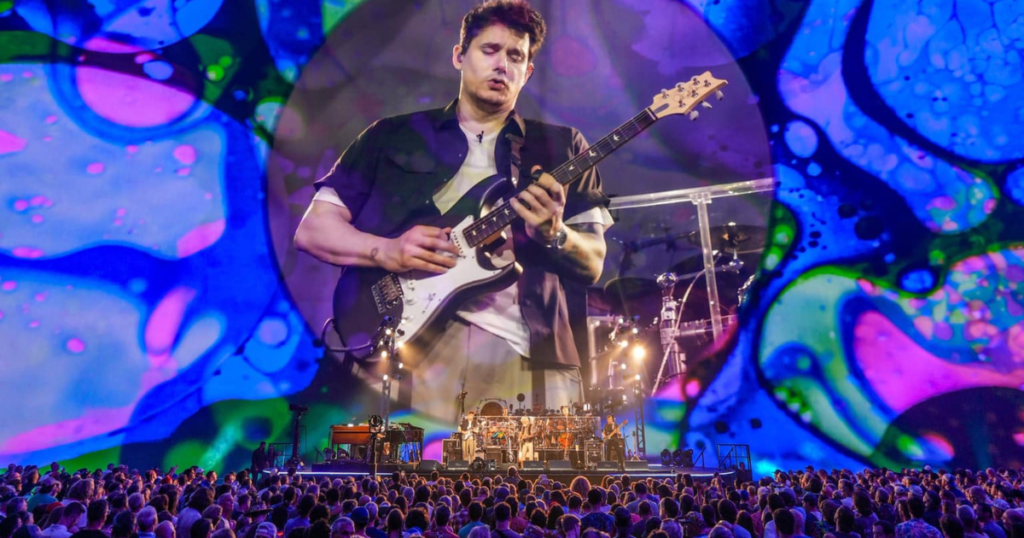
What John Mayer is doing right now is not a side chapter—it’s a defining phase of his career, and one that is actively reshaping how the Grateful Dead legacy moves forward in real time. This is no longer about Mayer stepping into an existing world. It’s about him helping architect what comes next.
At the center of that shift is his growing role as both interpreter and curator of the Grateful Dead catalog. His recently launched SiriusXM program, the “Grateful Dead Listening Party,” is not passive programming—it’s an active extension of the culture. Mayer is building a weekly touchpoint where deep cuts, live versions, and personal context converge into something that functions more like a guided archive than a traditional radio show. For longtime listeners, it adds depth. For newer audiences, it creates an accessible entry point into one of the most complex live music catalogs ever built.
This move signals something larger: Mayer is positioning himself not just as a performer of this music, but as one of its primary communicators in 2026. That distinction matters. The Grateful Dead’s catalog has always relied on interpretation, but it has rarely had a figure translating it in real time across modern platforms with this level of reach and consistency.
At the same time, Mayer is not pausing his own artistic evolution. His early-2026 international tour quietly marked one of the most significant expansions of his global footprint, with debut performances in markets like Mumbai, Bahrain, and Abu Dhabi. These were not one-off appearances—they were strategic entries into regions where his audience is still developing, signaling a long-term commitment to building a broader international presence.
That global expansion runs parallel to his next major studio effort. Mayer has confirmed that a new album is actively in progress, described as partially completed at the start of the year. This will be his first full-length release since Sob Rock, and based on his current trajectory, it is expected to reflect both his continued evolution as a songwriter and the musical depth he has developed through years of live improvisation within the Dead orbit. The intersection of those two identities—solo artist and improvisational player—is where his next record has the potential to stand apart.
His recent appearance alongside Ed Sheeran on Jimmy Kimmel Live! reinforced that dual positioning. Mayer remains fully embedded in mainstream visibility while simultaneously operating within a much deeper, more musically expansive lane. Very few artists are navigating both spaces at this level without compromising one for the other.
What makes this moment especially important is the uncertainty surrounding Dead & Company. While the group has not formally closed the door, there are currently no confirmed 2026 tour dates. That ambiguity has shifted attention directly onto Mayer—not as a replacement figure, but as a central driver of what the next iteration of this music could look like.
There is already growing conversation around flexible, collaborative formats—often described informally as “Dead & Friends”–style events—that would move away from a fixed band structure and toward a rotating collective. If that direction materializes, Mayer is positioned to be at the center of it, both musically and structurally.
This is where the ecosystem around the music becomes critical, and where platforms like the “Fare Thee Well Radio Show” play a meaningful role. The show functions as a connective layer between eras, focusing on the musical paths taken after the original Grateful Dead while keeping the catalog active through reinterpretation and broadcast. It reinforces the idea that this is not a closed archive—it’s an active, evolving body of work. Mayer’s current contributions align directly with that philosophy, even as he expands its reach through new channels.
What’s happening right now is not transitional—it’s foundational. Mayer is simultaneously expanding his solo career, building new audience pipelines globally, and stepping into a long-term role as a primary voice within one of the most significant live music legacies ever created. That combination is rare, and it places him in a position that extends far beyond collaboration.
The next phase of the Grateful Dead universe will not look like its past iterations. It will be more distributed, more platform-driven, and more globally connected. And at the center of that shift, whether through radio, live performance, or new recordings, John Mayer is not just participating—he’s shaping it.

