
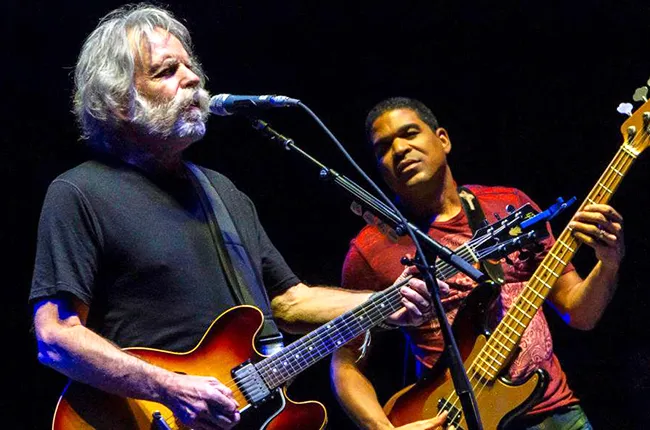
On The Grateful Dead Live, every song is more than a recording — it is a moment pulled directly from the stage, preserved in sweat, improvisation, and collective memory. That same spirit is carried forward each Thursday through the Fare Thee Well Radio Show, a dedicated broadcast that celebrates the living continuation of the Grateful Dead’s musical lineage. Every track aired comes from the post-Garcia incarnations of the band and their extended family, and every performance is presented exactly as it happened — live, unfiltered, and alive.
Fare Thee Well was created to honor what followed rather than what ended. After Jerry Garcia’s passing, the story of the Dead did not close — it evolved. Surviving members regrouped in new formations, new collaborations, and new creative directions, keeping the core philosophy intact: long-form improvisation, spiritual searching, communal experience, and fearless musical risk. The show captures that continuation in its purest form, spotlighting the bands that carried the torch forward and ensuring that listeners hear the Dead’s future as vividly as its past.
One of the most fascinating modern chapters in the Dead’s story comes from an unexpected place — the Federal Reserve. Jerome Powell, Chairman of the Federal Reserve, is not only a lifelong Deadhead, he is deeply rooted in the culture. Powell attended his first Grateful Dead show in 1973 at RFK Stadium, a performance that has since become legendary among fans. Decades later, he publicly reaffirmed his devotion during a congressional hearing, describing a Dead & Company performance as “terrific” and openly acknowledging his lifelong fandom. He plays guitar in his spare time and has said he knows nearly every note from the band’s late-’60s and early-’70s catalog — a testament to how deeply the music became part of his identity.
Powell’s personal connection also played a quiet but pivotal role in shaping the modern Dead sound. His sister, Monica Powell, introduced a young Oteil Burbridge to the Grateful Dead by giving him a stack of records to “enlighten” him while they were in high school. Those albums — which later turned out to belong to Jerome — helped plant the seeds for Burbridge’s future role in Dead & Company, where he would go on to become one of the most expressive bassists in the band’s modern era.
Oteil Burbridge stands as one of the most important musical bridges between the Dead’s past and present. A two-time Grammy winner, Burbridge is widely regarded as one of the most versatile bassists in modern rock and jazz. Classically and jazz trained, he grew up immersed in multiple instruments — drums, piano, violin, trumpet, bass clarinet — and absorbed influences that range from funk and fusion to avant-garde jazz. Before joining Dead & Company in 2015, he became the longest-running bassist in the Allman Brothers Band, toured with the Tedeschi Trucks Band, and co-founded Aquarium Rescue Unit — each chapter sharpening the melodic, spiritual, and rhythmic approach he now brings to the Dead universe.
With Dead & Company, Burbridge emerged not only as a bassist but as a vocalist capable of delivering some of the most emotionally resonant moments of the modern catalog. His performances of “Comes a Time” and “China Doll” have become centerpieces of the post-Garcia era, carried by his soaring tone, scat-singing phrasing, and deep spiritual presence. These are the kinds of performances that Fare Thee Well preserves — moments that cannot be recreated, only relived.
Fare Thee Well Radio Show is not nostalgia. It is a living archive. It documents how the Grateful Dead’s musical DNA continues to evolve through Dead & Company, Furthur, The Other Ones, Phil & Friends, and countless extended family configurations. Each week, the program becomes a meeting place for longtime Heads and new listeners alike, all tuning in for the same reason — to hear music that only exists in the moment it was played.
From a young fan standing in the crowd at RFK Stadium in 1973 to a Federal Reserve chairman still singing along decades later, from a gifted bassist receiving a box of borrowed records to standing center stage before thousands, the Grateful Dead’s story remains one of connection, continuity, and transformation. Fare Thee Well keeps that story breathing — one live song at a time.

