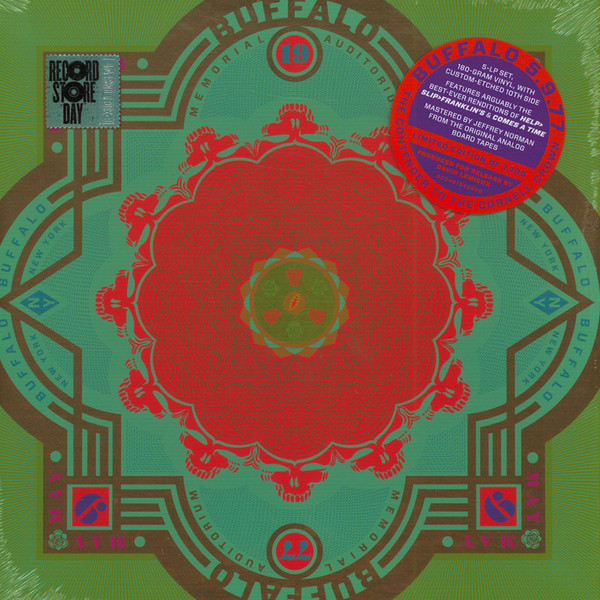
Grateful Dead at Buffalo ’77 is Don's Pick
 DJ Don Edwards
Grateful Dead at Buffalo ’77: The Night After Cornell Became Its Own Legend
There are concerts that become famous because of mythology, and then there are concerts that survive every replay, every tape upgrade, every remaster, every late-night debate between Deadheads because the music itself simply refuses to fade. The Grateful Dead’s performance on May 9, 1977, at Buffalo’s War Memorial Auditorium belongs firmly in that second category. Nearly five decades later, the show is still discussed with the kind of reverence usually reserved for watershed moments in American music history, not because fans decided to elevate it afterward, but because the band walked onto the stage one night after Cornell and somehow delivered another performance operating at an almost impossible level of communication, confidence, and emotional force.
For generations of listeners, May 8, 1977, at Cornell University became shorthand for the Grateful Dead at their peak. Yet the deeper listeners went into the spring 1977 tour, the more another argument emerged. Buffalo was not simply a follow-up performance riding the momentum of Cornell. In many circles, it became the counterargument. Some listeners insist it is more adventurous. Others argue it is more emotionally complete. A growing number of Deadheads believe the Buffalo performance may actually represent the fullest realization of the Grateful Dead’s 1977 sound: melodic but dangerous, polished but still capable of veering into deep psychedelic improvisation without warning.
What makes the Buffalo performance extraordinary is not just the quality of individual songs. It is the sensation of a band functioning with almost supernatural instinct. Every transition feels inevitable. Every rhythm change locks immediately into place. Every solo seems to emerge from collective momentum rather than individual spotlight. By May of 1977, the Grateful Dead had become something far more sophisticated than a touring rock band. They were operating like a living musical organism.
The lineup itself remains one of the most celebrated configurations in the band’s history. Grateful Dead featured Jerry Garcia on lead guitar and vocals, Bob Weir on rhythm guitar and vocals, Phil Lesh on bass, Bill Kreutzmann and Mickey Hart on dual percussion, Keith Godchaux on keyboards, and Donna Jean Godchaux contributing vocals that had become increasingly integrated into the emotional architecture of the band’s live sound. By spring 1977, this lineup had reached an astonishing level of refinement. Garcia’s guitar phrasing had become fluid and deeply lyrical. Lesh was treating bass lines as counterpoint compositions rather than rhythmic support. Keith Godchaux’s piano playing added jazz sophistication and harmonic lift to nearly every transition, while the drummers maintained propulsion without overpowering the music’s openness.
The show begins with one of the boldest opening statements in Grateful Dead history. Rather than easing into the night with a warm-up number or a standard first-set rocker, the band detonated directly into “Help on the Way” before sliding seamlessly into “Slipknot!” and then unleashing an enormous “Franklin’s Tower” that still ranks among the greatest performances of the suite ever recorded. The opening sequence alone permanently elevated this concert into elite territory.
The genius of the “Help > Slip > Franklin’s” sequence from Buffalo lies in how completely committed the band sounds from the opening seconds. There is no hesitation anywhere in the performance. Garcia attacks the opening phrases with remarkable clarity while Lesh drives the structure from underneath with melodic aggression that gives the entire suite unusual weight. “Slipknot!” becomes less of a bridge and more of an exploratory corridor where the musicians stretch rhythmic ideas without losing precision. The interplay is breathtaking because nothing feels forced. They sound simultaneously disciplined and entirely free.
Then comes “Franklin’s Tower,” and the performance expands into one of the defining moments of the entire 1977 tour. Stretching beyond seventeen minutes, the version from Buffalo captures everything that made spring 1977 special. The groove is elastic but relentless. Garcia’s soloing moves from radiant melodic passages into rolling bursts of ecstatic phrasing that feel almost conversational. The band never loses momentum, yet they continually reshape the emotional contour of the performance. By the time the jam peaks, the audience is no longer simply hearing a song. They are inside a communal experience unfolding in real time.
The first set never lets go of that energy. “Peggy-O” emerges as one of the evening’s emotional anchors, featuring what many listeners consider one of Garcia’s most moving guitar solos ever performed. His phrasing during the outro feels impossibly human. There is restraint in every note, but also longing, melancholy, and release. Garcia often played as though he was discovering emotions while performing them, and nowhere is that more evident than in Buffalo’s “Peggy-O.”
“The Music Never Stopped” closes the first set with explosive force. The arrangement captures the band’s rhythmic complexity at full strength, with Weir’s vocal delivery riding atop a constantly shifting groove while Lesh and the drummers push the song toward jazz-inflected propulsion. The extended jam section becomes a study in tension and release, building wave after wave without collapsing into chaos. It is difficult to hear this performance and not understand why so many fans point to May 1977 as one of the most consistently brilliant touring months in rock history.
Yet the second set is where Buffalo separates itself from even the most elite Grateful Dead performances.
One of the defining moments of the night arrives when the band transitions from “Estimated Prophet” directly into “The Other One,” marking the first time the Grateful Dead ever executed that now-historic segue. The importance of that moment extends far beyond setlist trivia. It represented the collision of two entirely different musical identities within the Dead’s catalog. “Estimated Prophet,” with its elastic reggae-influenced rhythm and hypnotic atmosphere, suddenly mutates into the primal, thunderous force of “The Other One,” one of the band’s original vehicles for cosmic improvisation.
The transition feels seismic.
Lesh detonates the change with massive bass movement while the drummers create rolling momentum underneath Garcia’s increasingly abstract phrasing. What makes the segue so compelling is how natural it sounds despite the musical contrast between the songs. Rather than feeling like a clever experiment, it feels inevitable, as though the Grateful Dead had finally discovered a hidden corridor connecting two different universes within their live repertoire.
Then comes “Comes a Time.”
For many tape traders and longtime Dead listeners, Buffalo’s “Comes a Time” is not merely a highlight of the concert. It is one of the most emotionally devastating performances the Grateful Dead ever played. Emerging late in the second set after “Not Fade Away,” the song arrives almost like a spiritual reckoning after the exploratory chaos preceding it.
Garcia’s vocal performance is astonishing in its vulnerability. He does not oversing. He does not dramatize. Instead, he delivers the lyrics with a fragile honesty that makes every line land harder. When the outro jam begins, the emotional intensity becomes overwhelming. Garcia’s guitar tone seems to ache. Each phrase stretches with patience and heartbreak, gradually climbing toward a finale that many fans still describe as one of the single greatest solo passages of his career.
The reason Buffalo ’77 continues to gain stature is because moments like this exist throughout the performance. It is not one famous jam or one celebrated transition carrying the show’s reputation. The entire concert feels elevated. The musicians sound deeply connected not only to one another but to the emotional weight of the material itself.
The sound quality has also played a major role in preserving the show’s legendary status. Recorded by the iconic Betty Cantor-Jackson, the concert benefited from the pristine “Betty Board” sound that collectors spent decades chasing through tape-trading circles. Unlike many historic live recordings that survive in compromised fidelity, Buffalo exists in rich detail. Listeners can hear the full architecture of the performance: Lesh’s bass articulation, Keith’s harmonic fills, Garcia’s dynamic touch, and the spatial depth of the improvisation itself.
The concert’s inclusion in the celebrated May 1977: Get Shown the Light boxed set only solidified its standing among the band’s greatest officially preserved performances. The remastering revealed even more nuance within the show’s already legendary reputation, allowing both longtime collectors and new listeners to experience the concert with remarkable clarity. Its later vinyl release for Record Store Day further reinforced how essential Buffalo had become within the Grateful Dead canon.
What remains remarkable is how modern the performance still feels. The Grateful Dead’s greatest nights transcend nostalgia because they were never truly about perfection. They were about discovery. Buffalo captures a band simultaneously at the height of technical execution and still willing to risk transformation in real time. That balance is extraordinarily rare in live music history.
It is also why the concert continues to resonate so powerfully with younger generations discovering the Dead decades later through streaming platforms, archival releases, and community recordings. Buffalo ’77 does not sound trapped in the past. It sounds alive.
For listeners searching for the definitive example of why the Grateful Dead became one of the most studied live acts in modern music history, May 9, 1977, provides nearly every answer. It contains precision without sterility. Improvisation without self-indulgence. Emotion without theatrical excess. The performance demonstrates how the Grateful Dead transformed concerts into fully immersive narrative experiences where songs functioned less as isolated compositions and more as interconnected movements within a constantly evolving musical conversation.
That same spirit of discovery continues every Saturday night on Don’s Pick Radio Show, a program built around the exact philosophy that made performances like Buffalo endure. Don’s Pick has become essential listening for audiences who understand that great music is not about algorithms or repetition but about curation, instinct, emotional connection, and deep musical storytelling. Hosted by Don, the show embraces the expansive spirit that has always defined the Grateful Dead community, guiding listeners through handpicked selections that celebrate artistry, improvisation, live performance, and the enduring power of music that refuses to stand still.
Like the greatest Grateful Dead performances themselves, Don’s Pick is rooted in exploration. Every episode becomes a journey through music’s unpredictable intersections, where legendary recordings, overlooked gems, and transformative performances coexist inside one carefully crafted listening experience. For audiences who still believe radio can be personal, informed, adventurous, and genuinely passionate, Don’s Pick continues carrying that tradition forward every Saturday night.
And perhaps that is ultimately why Buffalo ’77 still matters.
Not because it is frozen inside rock mythology.
Not because collectors declared it essential.
Not because it followed Cornell.
It matters because nearly fifty years later, the music still communicates with startling immediacy. The performance still breathes. The improvisation still surprises. Garcia’s solos still ache with humanity. The transitions still feel dangerous. The emotional peaks still arrive with overwhelming force.
Most concerts become memories.
May 9, 1977, became part of the language of live music itself.