Mickey Hart Is Making Art
With Sound Waves, Subwoofers,
and Cosmic Radio Frequencies
Rhythm made visible. Paint moved by gamma waves and solar wind impulses. Nearly 100 original works displayed in San Francisco. And Planet Drum Circle starting up right now on The Grateful Dead Live.
He Does Not Use Brushes. He Uses Subwoofers, Mathematical Beam Tones, and the Physics of Sound.
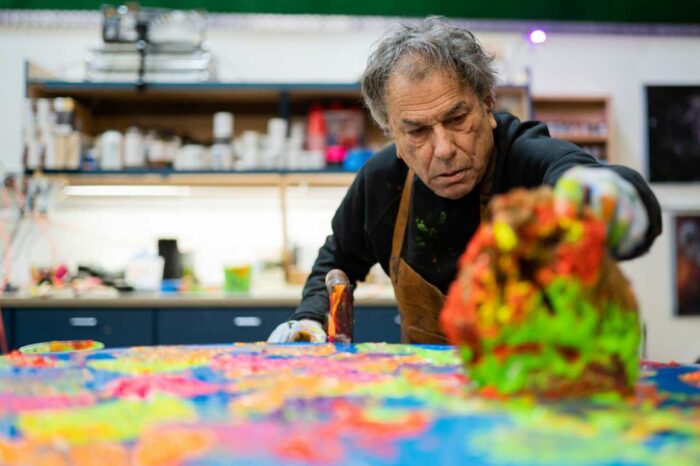
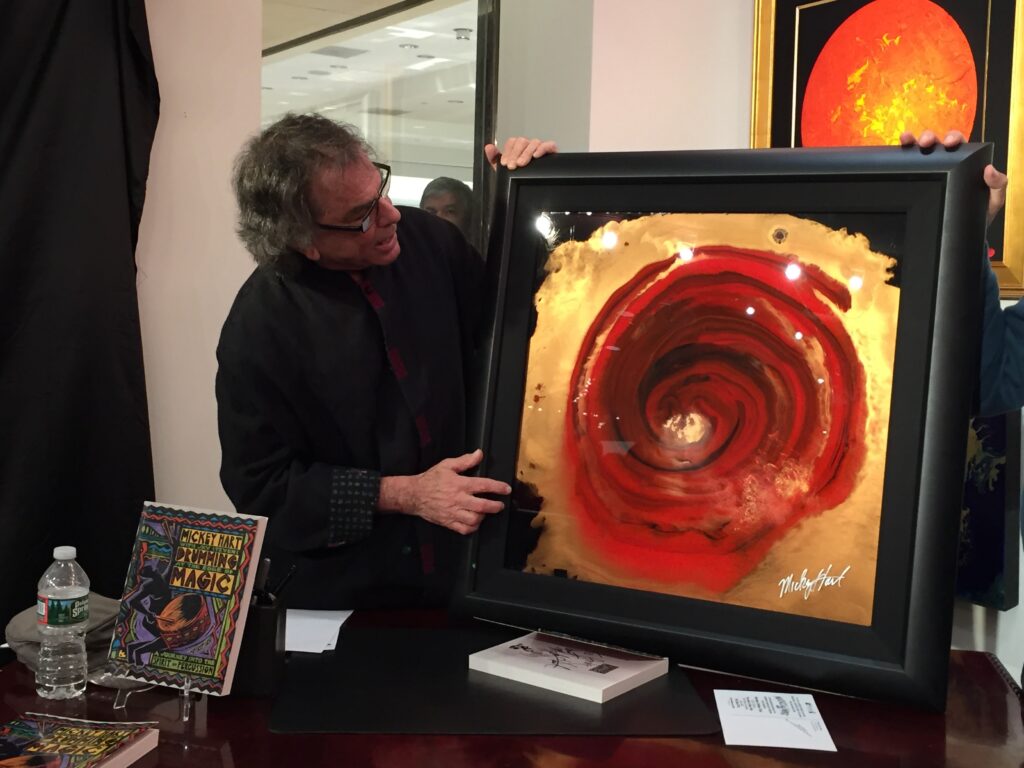
Vibrational Expressionism is the fine art discipline developed by Mickey Hart over decades of working at the intersection of percussion, science, and visual form. The process is exactly what the name describes: sound waves physically manipulate wet paint to create the art. Hart does not apply paint with a brush or any conventional tool. He places paint on canvas or plexiglass surfaces and subjects them to extreme low-frequency vibrations, channeling mathematical beam tones and gamma waves through Meyer Sound subwoofers and other heavy physical sound systems. The gravity and centrifugal forces cause the paint to bubble, boil, and separate in patterns that cannot be predicted or controlled — capturing, in Hart’s own framing, rhythm made visible.
The result is large-scale work that looks like nothing produced through conventional studio painting. The patterns that emerge are determined by the acoustic physics of the specific frequencies used, the viscosity and density of the paint, the surface it lands on, and the interaction between all three in real time. No two pieces can be replicated. The artwork is a recording of a sonic event in the same way that a concert recording is a document of a musical performance — a trace of something that happened once and cannot happen again in the same form.
The gravity and centrifugal forces cause the paint to bubble, boil, and separate unpredictably, capturing rhythm made visible — a physical record of acoustic energy translated onto canvas through sound alone.
Mickey Hart · Vibrational ExpressionismSonic Poured Painting. Cosmic Data Sonification. Multi-Sensory Gallery Environments.
Paint Moved by Physical Sound Systems and Mathematical Beam Tones
Hart places paint on surfaces and subjects them to extreme low-frequency vibrations, using Meyer Sound subwoofers to channel mathematical beam tones and gamma waves. The physics of gravity and centrifugal force do the work that a brush would normally do — but the results are entirely unpredictable, determined by the interaction of acoustic energy, paint viscosity, and surface material in real time. No two pieces can be replicated because no two sonic events are identical.
Radio Frequencies From Solar Wind, Cosmic Phenomena, and Biological Rhythms
The auditory inputs driving the paint movement often originate far beyond any conventional musical source. Hart captures radio frequencies from cosmic phenomena, solar wind impulses, and biological rhythms — including the electrical activity of stem cells — and translates them into low-end sound waves that physically imprint on the canvas. The artwork becomes a visual record of forces operating at scales both vastly larger than any concert hall and vastly smaller than any instrument.
Blacklight Pigments, Backlit Frames, and Ambient Rhythmic Sound Rooms
The major exhibitions extend the work beyond individual canvases into full environmental experiences. Pieces include large poured works on plexiglass rendered with blacklight-sensitive pigments, backlit picture-window frames that make the paint patterns luminous, and interactive rooms designed to play ambient, deeply layered rhythmic compositions while viewers move through the space. The gallery environment itself becomes a sonic and visual installation rather than a neutral container for objects on walls.
Art at the Edge of Magic at the Haight Street Art Center · Forever Grateful at Golden Gate Park
Two major San Francisco exhibitions have brought Hart’s visual work before the public in 2026, together representing the most significant public presentation of Vibrational Expressionism to date.
Hart’s largest museum exhibition to date, featuring nearly 100 original works alongside the physical creation devices used to make them and a dedicated multi-sensory audio layout. The exhibition brought the full scope of Vibrational Expressionism into a gallery context for the first time at this scale, including pieces created with cosmic data sonification alongside works driven by gamma wave inputs and biological rhythm recordings.
Hart’s visual pieces returned to San Francisco’s Golden Gate Park as part of the broader Forever Grateful exhibition, which also houses Ken Kesey’s Furthur bus — leaving Oregon for the first time since 1969 — and Jerry Garcia’s personal BMW on public display for the first time. Hart’s paintings occupy a dedicated wing within the exhibition running through October 25, 2026, presented in the context of the full sweep of Grateful Dead cultural history.
Planet Drum Circle With Mickey Hart and Bill Kreutzmann Is Starting Up Right Now

An invigorating hour-long rhythmic journey through the vibrant world of percussion, led by Mickey Hart and Bill Kreutzmann. Broadcasting every Sunday from 11 AM to noon Eastern, Planet Drum Circle is a testament to the power of rhythm and the universal language of music — the same obsession that drives Hart’s visual art is the same one that drives every hour of this show. It is starting right now on The Grateful Dead Live.
The connection between Hart’s visual art and Planet Drum Circle runs deeper than shared authorship. The same fascination with rhythm as a fundamental force — one that predates music, predates language, and operates at biological, geological, and cosmic scales — is what drives both the weekly broadcast and the paintings on the gallery walls. Vibrational Expressionism is what happens when you ask what rhythm looks like. Planet Drum Circle is what happens when you ask what it sounds like. Hart has been answering both questions for decades, and this morning he is answering the second one on the channel.