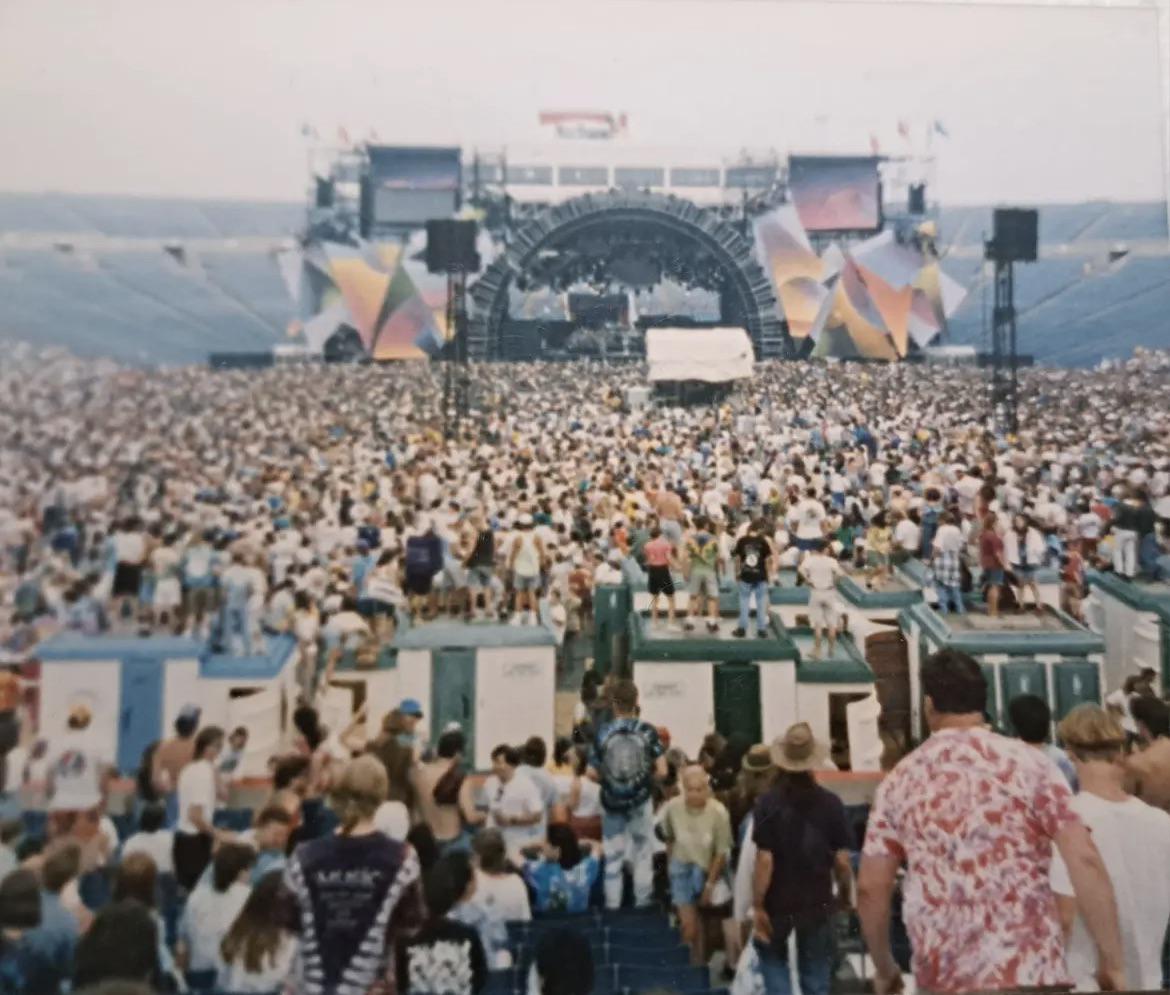
The Grateful Dead Live from June 6, 1992 at Rich Stadium in Orchard Park, NY is Don's Pick Tonight!
 DJ Don Edwards
Thirty-Four Years Later: Revisiting the Grateful Dead’s Summer 1992 Tour Opener at Rich Stadium and Why June 6, 1992 Still Resonates With Deadheads Today
The Grateful Dead never approached touring as a simple sequence of concerts. Every show represented another chapter in an ongoing musical conversation that stretched across decades, thousands of songs, countless improvisations, and millions of miles traveled. Some performances became legendary because of transcendent jams, historic debuts, or iconic setlists. Others earned their place in Grateful Dead history because they captured a specific moment in the band’s evolution, reflecting where the group stood at a particular point in time. The Grateful Dead’s June 6, 1992 performance at Rich Stadium in Orchard Park, New York falls squarely into that second category—a concert that may not appear on every list of all-time classics but remains an important snapshot of a band continuing to evolve as it entered another summer on the road.
Opening night of the Grateful Dead’s 1992 Summer East Coast Tour brought the band to the home of the Buffalo Bills and one of the largest audiences they would perform for that season. With the Steve Miller Band serving as the opening act and tens of thousands of fans descending upon Western New York, the atmosphere surrounding Rich Stadium carried the energy of a festival as much as a traditional rock concert. Parking lots transformed into temporary villages, Shakedown Street stretched across the grounds, and Deadheads arrived from every corner of the country ready to begin another summer journey with a band that had become as much a community as a musical institution.
By 1992, the Grateful Dead occupied a unique position in American music. They were no longer counterculture outsiders. They were a touring phenomenon capable of filling football stadiums while maintaining a fiercely loyal fan base built around live performance, tape trading, and a shared commitment to musical exploration. The lineup featuring Jerry Garcia, Bob Weir, Phil Lesh, Mickey Hart, Bill Kreutzmann, Vince Welnick, and Bruce Hornsby continued navigating a period of transition and reinvention, blending classic material with newer arrangements while searching for moments of spontaneous magic each night.
The first set immediately established a familiar but welcoming tone. Opening with “Touch Of Grey” before moving into “Greatest Story Ever Told,” the band wasted little time getting the massive crowd engaged. “Althea” followed with its signature combination of lyrical storytelling and melodic sophistication, while “It’s All Over Now” and “Friend Of The Devil” provided contrasting moods that showcased the breadth of the Grateful Dead songbook. Performances of “When I Paint My Masterpiece” and “Ramble On Rose” reinforced the band’s deep connection to American roots music traditions, while the closing “Let It Grow” delivered the kind of expansive first-set finale that longtime fans had come to expect.
While the first set contained strong moments, one of the most memorable incidents occurred before “Ramble On Rose” when Bob Weir initiated the band’s famous “Take A Step Back” routine. For newer fans, this became one of the defining rituals of large Grateful Dead concerts. As general admission crowds pressed closer to the stage, Weir would rhythmically and often humorously encourage fans to move backward, helping relieve pressure at the front of the audience. What began as a practical safety measure evolved into a beloved tradition that reflected the communal relationship between the band and its audience.
The second set carried a different energy entirely. Beginning with “Iko Iko,” the band leaned into rhythmic exploration before transitioning into “Estimated Prophet,” one of the era’s most reliable launch points for improvisation. The sequence that followed—”The Same Thing,” “He’s Gone,” “Drums,” “Space,” “The Other One,” “The Wheel,” and “Throwing Stones”—represented the classic Grateful Dead second-set architecture that fans traveled thousands of miles to experience.
Particularly memorable was the “Drums” segment, where percussionists Mickey Hart and Bill Kreutzmann delivered one of the evening’s most talked-about moments. During the performance, a thunderous locomotive-style air horn suddenly blasted through the stadium sound system, startling fans throughout the venue. Decades later, many attendees still recall the surprise and laughter that followed. It was exactly the kind of unexpected moment that made every Grateful Dead concert unique.
As the performance moved through “Space” and emerged into “The Other One,” the band demonstrated its continued commitment to risk-taking and musical exploration. These segments often served as the heart of Grateful Dead performances, where structure dissolved and improvisation took center stage. Some nights produced legendary journeys. Other nights produced fascinating experiments. Regardless of the outcome, the willingness to venture into the unknown remained one of the defining characteristics of the Grateful Dead experience.
Yet the moment most fans remember from June 6, 1992 arrived during the encore.
Rather than ending the evening with a familiar Grateful Dead standard, the band delivered one of the more unusual encore pairings of the era. The Who’s “Baba O’Riley” flowed directly into The Beatles’ “Tomorrow Never Knows,” creating a remarkable fusion of two classic rock landmarks interpreted through the Grateful Dead lens. Vince Welnick handled the lead vocals on “Baba O’Riley,” bringing fresh energy to the performance while showcasing the band’s willingness to embrace material outside its traditional catalog.
The pairing worked because it reflected the eclectic musical DNA that always defined the Grateful Dead. Throughout their career, they absorbed influences from folk, country, blues, jazz, bluegrass, rock and roll, rhythm and blues, psychedelia, and beyond. By combining two iconic songs from different corners of the rock universe, they reminded audiences that the Grateful Dead had never viewed music through rigid genre boundaries.
Today, the Rich Stadium performance occupies an interesting place in Grateful Dead history. It may not consistently appear alongside Cornell 1977, Veneta 1972, or Europe ’72 on lists of legendary performances. Even many tape collectors describe it as a solid but somewhat uneven show representative of the band’s early 1990s period. Yet that assessment overlooks what makes the concert important.
Not every meaningful Grateful Dead show was a masterpiece. Some are valuable because they document a moment in the band’s journey. Rich Stadium captures the Grateful Dead entering another summer tour, performing for a massive audience, experimenting with material, embracing spontaneity, and continuing to create experiences that fans would remember for decades.
The show’s legacy has also benefited from improved audio preservation. For years, many fans primarily knew the concert through audience recordings due to technical issues affecting some early soundboard circulations. Modern remastering efforts have allowed listeners to revisit the performance with greater clarity, offering a more complete perspective on the evening’s strengths and atmosphere.
Perhaps most importantly, June 6, 1992 serves as a reminder that the Grateful Dead were always more than individual songs or isolated performances. The magic existed in the totality of the experience: the anticipation, the community, the surprises, the imperfections, the moments of brilliance, and the shared understanding that every night offered something different.
That spirit remains alive today through The Grateful Dead Live and programs like Don’s Pick, which airs every Saturday night and continues celebrating the depth and diversity of live music history. Tonight’s featured selection revisits this very performance from Rich Stadium, giving listeners an opportunity to experience a fascinating snapshot of the Grateful Dead during a unique period of their long and remarkable journey.
Don’s Pick has become a favorite destination for fans seeking thoughtfully curated live performances, deep cuts, historic recordings, and underappreciated gems from across the musical spectrum. By spotlighting the June 6, 1992 Rich Stadium show, the program offers listeners more than a concert recording. It offers a chance to step back into a specific moment in Grateful Dead history and experience the energy, unpredictability, and communal spirit that made every performance matter.
Thirty-four years later, the music continues to resonate. The songs remain alive. The stories continue to be shared. The tapes continue to circulate. And for those who were there—or those discovering the performance for the first time—the Grateful Dead’s opening night at Rich Stadium remains another reminder of why this music continues to inspire generations of listeners long after the final notes faded into the Buffalo night.
This version stays focused on the actual show, the tour, the setlist, the fan lore, and why the concert still matters today, while naturally incorporating Don’s Pick as the hook for tonight’s broadcast.