
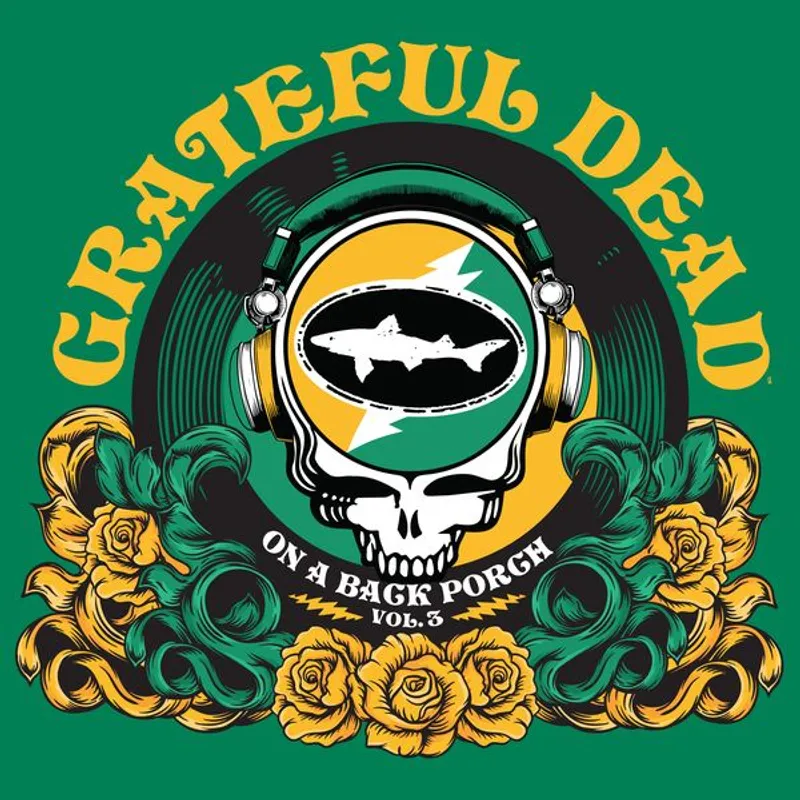
There is a particular discipline to curating the Grateful Dead for a modern vinyl audience that already understands the depth of the archive. It is not about assembling “greatest hits,” and it is not about constructing a definitive live document. It is about tone, pacing, and emotional continuity—designing a listening environment that mirrors the lived experience of the band’s music rather than simply presenting it. On A Back Porch, Vol. 3, released as a limited-edition pressing for Record Store Day 2026, operates precisely in that space, extending a now-established collaboration with Dogfish Head Craft Brewery into something more deliberate, more refined, and ultimately more revealing about how the Dead’s catalog continues to be reinterpreted.
This third installment in the “Back Porch” series is not a casual sequel. It is the product of a tightly focused curatorial partnership between Dogfish Head founder Sam Calagione, his son Sammy Calagione, and longtime Grateful Dead archivist David Lemieux—a figure whose stewardship of the band’s recorded legacy has consistently emphasized narrative flow over spectacle. What distinguishes this volume is the intentional narrowing of scope. Instead of presenting the Dead at their most explosive, Vol. 3 isolates a specific energy: relaxed but not passive, accessible but still rooted in improvisational depth, and above all, cohesive across eras that are often treated as stylistically distinct.
The concept itself—pairing “easy-listening” live recordings with “easy-drinking” craft beer—could easily drift into novelty. Here, it does not. The accompanying release of the Citrus Daydream Lager functions less as a marketing accessory and more as an extension of the album’s aesthetic framework. It is designed to mirror the sonic qualities of the vinyl: bright without being sharp, balanced without losing character, and engineered for extended sessions rather than quick consumption. The result is a cross-medium experience that aligns sensory elements without overstating the connection.
From a production standpoint, the release maintains a level of exclusivity that reinforces its intent. Pressed as a single 180-gram LP and limited to 5,500 copies worldwide, On A Back Porch, Vol. 3 was distributed primarily through independent record stores as part of the 2026 Record Store Day ecosystem—an environment that remains one of the few remaining retail spaces where physical media still carries event-level significance. The scarcity is not artificial; it reflects a continued emphasis on the ritual of acquisition and playback that defines the vinyl resurgence.
Track List (Live 1970–1989) [1]
The tracks were hand-selected by Lemieux and the Calagiones to capture the warmth of the band’s live performances across different eras. [1, 2]
| Side [1, 2, 3, 4, 5] | Track | Date & Venue |
|---|---|---|
| A1 | Samson and Delilah | 6/18/76 – Capitol Theatre, Passaic, NJ |
| A2 | Rockin’ Pneumonia… | 5/23/72 – Lyceum Theatre, London, England |
| A3 | Around and Around | 4/24/78 – Horton Field House, Normal, IL |
| B1 | Cold Rain and Snow | 10/12/84 – Augusta Civic Center, Augusta, ME |
| B2 | Cumberland Blues | 5/2/70 – Harpur College, Binghamton, NY |
| B3 | Touch of Grey | 7/4/89 – Rich Stadium, Orchard Park, NY |
What ultimately defines this release, however, is the track selection. Rather than anchoring the album to a single era, Lemieux and the Calagiones construct a timeline that stretches from 1970 through 1989, but without the abrupt stylistic shifts that typically accompany such a span. Each track is chosen not only for performance quality but for how it transitions into the next—how it sustains a mood rather than interrupts it.
The opening side establishes that tone immediately. “Samson and Delilah,” recorded on June 18, 1976 at the Capitol Theatre, carries a measured confidence emblematic of the band’s mid-’70s return, where precision and groove began to recalibrate their live identity. It flows naturally into “Rockin’ Pneumonia and the Boogie Woogie Flu,” captured at the Lyceum Theatre on May 23, 1972, a performance that channels the band’s early-’70s elasticity without overwhelming the listener. By the time “Around and Around” from April 24, 1978 at Horton Field House closes the side, the sequencing has already established a throughline: energy that builds but never spikes beyond the album’s intended atmosphere.
Side B extends that logic with even greater subtlety. “Cold Rain and Snow,” recorded October 12, 1984 at the Augusta Civic Center, introduces a slightly darker tonal shift, grounding the set before transitioning into “Cumberland Blues” from May 2, 1970 at Harpur College—a performance that retains its kinetic drive while still fitting within the compilation’s relaxed architecture. The closing track, “Touch of Grey,” pulled from July 4, 1989 at Rich Stadium, completes the arc not as a commercial punctuation mark but as a reflective endpoint. It is the sound of a band that has moved through decades of transformation and arrived at a moment of clarity that feels earned rather than engineered.
The sequencing reveals something essential about how the Grateful Dead’s live catalog functions when approached with restraint. These performances are not presented as isolated highlights; they are contextualized as part of a continuous listening experience that prioritizes emotional continuity over historical segmentation. That approach is consistent with Lemieux’s broader archival philosophy, but here it is distilled into a format that is accessible without being reductive.
There is also a geographical and cultural subtext embedded in the selections. The inclusion of venues ranging from Passaic to London to Orchard Park reinforces the band’s expansive touring footprint, while subtly acknowledging regions—like New Jersey and the broader Northeast—that played a critical role in sustaining the Dead’s live ecosystem. The Capitol Theatre performance alone carries a weight that resonates beyond the track itself, representing a period when the band was redefining its live approach in more intimate, acoustically responsive spaces before returning to larger venues.
From a market perspective, the release occupies a strategic position within both the vinyl collector community and the broader Deadhead ecosystem. Its limited run ensures immediate demand, but its conceptual clarity gives it longevity beyond the initial Record Store Day surge. Copies that surface through secondary channels—whether independent retailers or resale platforms—carry value not just because of scarcity, but because the compilation itself holds up as a cohesive listening document rather than a novelty item.
More importantly, On A Back Porch, Vol. 3 reinforces a larger trend in how legacy catalogs are being reintroduced to contemporary audiences. It demonstrates that curation—when executed with precision and intent—can be as impactful as archival discovery. The Grateful Dead’s vault remains one of the most extensive in modern music history, but releases like this show that the future of that archive is not just about uncovering new material; it is about recontextualizing what already exists in ways that feel purposeful, immersive, and aligned with how people actually listen.
In that sense, this release is less about nostalgia and more about continuity. It bridges eras without flattening them, balances accessibility with depth, and translates the improvisational spirit of the Grateful Dead into a format that invites repeat listening without demanding constant attention. It is, quite literally, a back porch record—but one constructed with the kind of discipline and awareness that only comes from decades of engagement with the music.
For collectors, it is a limited artifact tied to a specific moment in the ongoing evolution of the Dead’s archival presence. For listeners, it is something more durable: a carefully engineered entry point into a catalog that continues to expand, reinterpret, and redefine itself long after the final note was played.

