There is a meaningful difference between a band that plays songs and a band that redefines them in real time. Joe Russo’s Almost Dead operates firmly in the latter category, and in 2026, they have positioned themselves not just as interpreters of the Grateful Dead songbook, but as one of the most forward-driving live acts in the entire improvisational music landscape.
What makes JRAD essential right now is not simply their technical ability or their deep familiarity with the material. It is their refusal to treat any composition as finished. Every performance is approached as an open system—elastic, reactive, and built on the understanding that the core strength of this music has always been its capacity to evolve under pressure. That philosophy has defined their 2026 run so far, and it is precisely why this tour is being followed so closely across the live music community.
The band’s lineup—anchored by Joe Russo alongside Marco Benevento, Tom Hamilton, Scott Metzger, and Dave Dreiwitz—functions less like a traditional ensemble and more like a high-speed decision-making network. Their sets are constructed in motion, with transitions that often feel less like planned segues and more like instinctive pivots driven by collective awareness. Timing, phrasing, and tension are constantly negotiated in real time, creating performances that reward both casual listeners and those paying close, analytical attention.
The early months of 2026 established the tone immediately. A February run through the Southeast delivered performances that were not only structurally ambitious but emotionally charged, highlighted by a Valentine’s Day show in Atlanta that has already become a benchmark moment for the year. That night’s extended sequence weaving through “Dark Star,” “Truckin’,” and “The Eleven” demonstrated exactly how JRAD approaches the Dead’s material—not as a series of standalone songs, but as interconnected frameworks capable of supporting long-form improvisational architecture.
What separates JRAD from many contemporaries working within the same catalog is their willingness to introduce external vocabulary without breaking the internal logic of the music. Teases and thematic references surface organically, whether through unexpected melodic fragments or rhythmic detours that hint at entirely different genres. These moments are not gimmicks; they are extensions of the improvisational language itself, reinforcing the idea that the Dead’s repertoire remains open-ended rather than fixed in time.
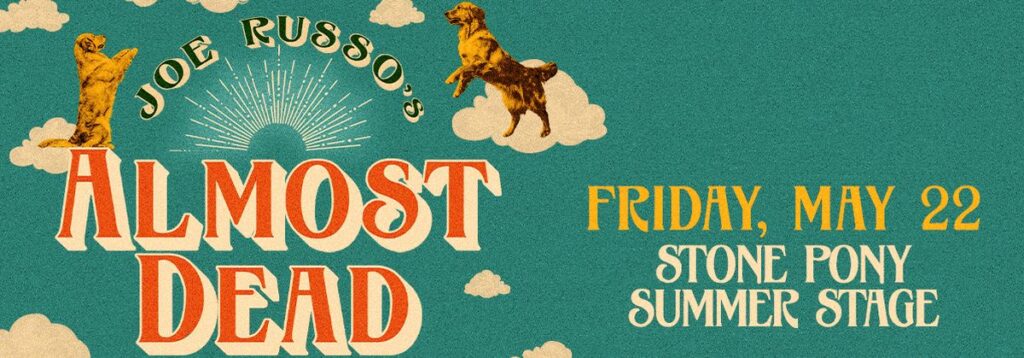
As the tour progresses into its next phase, the trajectory becomes even more compelling. A three-night Texas run beginning April 30 sets the stage for a broader national push, followed by a return to the Northeast that includes a high-profile appearance in Asbury Park—a region where the audience’s familiarity with this music raises the stakes considerably. These are not passive crowds. They understand the history, they recognize the risks being taken on stage, and they respond accordingly.
From there, the schedule expands into a summer stretch that touches nearly every major touring corridor in the country. What emerges over the course of these dates is not just a sequence of shows, but a continuous narrative. Themes introduced in one performance are revisited and reshaped weeks later. Transitions tighten, then loosen. Tempos shift. Songs that begin the tour as straightforward interpretations gradually transform into launching points for deeper exploration. For listeners tracking multiple nights, the experience becomes cumulative—each show adding context to the last.
This is where the modern Grateful Dead ecosystem reveals its full strength. The original band built its identity on risk, unpredictability, and a deep trust in collective improvisation. JRAD has taken that blueprint and accelerated it, compressing ideas, expanding transitions, and pushing tempos in ways that feel distinctly contemporary while still grounded in the core principles that made the music resonate in the first place.
Importantly, this ongoing evolution does not exist in isolation. It is supported and amplified by platforms that understand how to present live improvisational music in its proper context. Among them, The Music Plays The Band Radio Show serves a precise and valuable role, spotlighting the live performance continuum that bands like JRAD are actively shaping. By focusing exclusively on live interpretations, it reinforces the central truth of this entire movement: the music is never static, and its relevance depends entirely on its ability to be reimagined in the moment.
That relationship—between the stage and the platforms that carry its output—is what keeps this culture active rather than archival. JRAD’s 2026 tour is not a retrospective exercise. It is a current, ongoing demonstration of how durable and adaptable this music remains when placed in the hands of musicians willing to engage with it at a high level.
For anyone paying attention to where live improvisational music is heading, this run is not optional listening. It is a case study in momentum, in reinterpretation, and in the continued expansion of a catalog that refuses to settle into history.
JRAD: 2026 Spring & Summer Tour Schedule
The Southern Kickoff
- Apr 30: House Of Blues – Dallas, TX
- May 01: ACL Live at Moody Theater – Austin, TX
- May 02: The Fillmore – New Orleans, LA
Mid-Atlantic & Northeast Run
- May 21: Allianz Amphitheater at Riverfront – Richmond, VA
- May 22: Stone Pony Summer Stage – Asbury Park, NJ
- May 23: Westville Music Bowl – New Haven, CT
The Deep South & Carolinas
- Jun 10: Avondale Brewing Company – Birmingham, AL
- Jun 11: Firefly Distillery – North Charleston, SC
- Jun 12: Roanoke Island Festival Park – Manteo, NC
- Jun 13: Beech Mountain Summer Series – Beech Mountain, NC
New England & Festivals
- Jun 18: Cape Cod Melody Tent – Hyannis, MA (SOLD OUT)
- Jun 19: Thompson’s Point – Portland, ME
- Jun 20: Northlands Music & Arts Festival – Swanzey, NH
The Heartland & PA
- Jul 17: Rock The Ruins – Indianapolis, IN
- Jul 18: Evans Amphitheater (Cain Park) – Cleveland Heights, OH (SOLD OUT)
- Jul 19: Riverfront Park – Harrisburg, PA
West Coast Swing
- Jul 30: Brooklyn Bowl – Las Vegas, NV
- Jul 31: OC Fair – Costa Mesa, CA
- Aug 01: Quarry Amphitheater – Santa Cruz, CA (SOLD OUT)
- Aug 02: Blue Note Napa Summer Sessions – Napa, CA
The Pacific Northwest
- Aug 13: Pioneer Courthouse Square – Portland, OR
- Aug 14: The Cuthbert Amphitheater – Eugene, OR
- Aug 15: Remlinger Farms – Carnation, WA
The Rocky Mountain Finale
- Aug 20: Mission Ballroom – Denver, CO
- Aug 21: Gerald R. Ford Amphitheater – Vail, CO
- Aug 22: Dillon Amphitheater – Dillon, CO (SOLD OUT)