Some concerts end when the house lights come up. Others end when the last musician leaves the stage, when the parking lot clears, when the recording is finally shelved and the tour bus pulls away for the last time. And then there is a third category — a very small one — where the ending never quite arrives. Where something that happened on a specific stage, on a specific night, in a specific city, keeps reverberating outward long after every practical definition of “over” has been satisfied. The Grateful Dead’s Fare Thee Well concerts at Chicago’s Soldier Field in July 2015 belong to that third category, and tonight’s Fare Thee Well Radio Show on The Grateful Dead Live is the right occasion to sit with what those three nights meant, what they produced, and why the music they celebrated remains as urgent and alive as it has ever been.
The Fare Thee Well Radio Show exists as a direct expression of something the Grateful Dead always understood: that the music does not die when a band stops playing. It migrates. It finds new homes in the projects, the collaborations, the bands and solo ventures that surviving musicians build in the wake of something large and shared coming to its close. The show is dedicated to exactly that migration — to the post-Garcia musical lives of the band’s surviving members, to the ensembles they formed and the performances they gave in the years after Jerry Garcia’s passing in 1995, and to the ongoing question of what it means to carry forward a musical tradition that was always, at its core, about finding something new inside something familiar.
Tonight, that question has a specific and magnificent answer: three nights in Chicago, ten years ago now, when the Core Four gathered one last time and the community that had formed around thirty years of Grateful Dead music responded with a devotion that broke attendance records and moved millions of people around the world.
Why Chicago, Why Soldier Field, and Why It Mattered
The choice of Soldier Field as the venue for the Fare Thee Well concerts was not incidental. It was the kind of choice that communicates meaning before a single note is played, and everyone who understood the band’s history understood it immediately. Soldier Field in Chicago was the site of Jerry Garcia’s final concert with the Grateful Dead on July 9, 1995 — the last time the original band appeared on a stage together before Garcia’s death less than a month later. Returning to that specific venue twenty years later, for a formal farewell from the surviving members, was an act of deliberate symbolic weight. It was a closing of a circle. A return to the place where something ended, this time to say goodbye properly and on the community’s own terms.
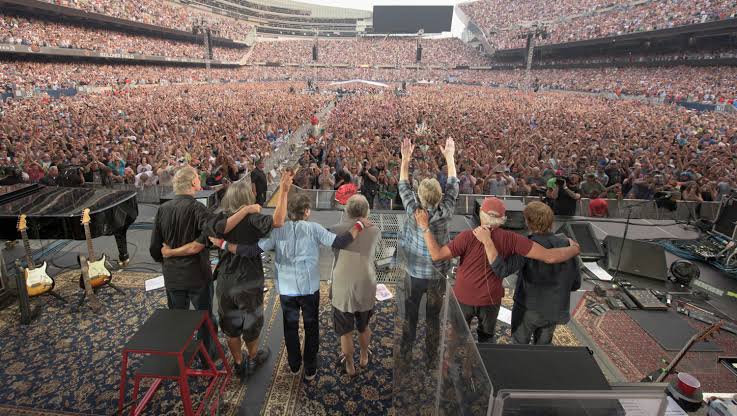
The “Core Four” who assembled for those three nights in July 2015 were Mickey Hart, Bill Kreutzmann, Phil Lesh, and Bob Weir — the four surviving original members of the Grateful Dead who had been present for the entirety of the band’s journey from the mid-1960s psychedelic San Francisco underground to the amphitheaters and stadiums of the 1990s. Their presence together at Soldier Field represented something that many fans had believed might never happen: a formal, public acknowledgment from the people who made the music that the community built around it deserved a proper farewell.
Joining the Core Four were three guest musicians whose involvement deepened the significance of the event considerably. Trey Anastasio, the lead guitarist and vocalist of Phish, stepped into the lead guitar role with the seriousness and preparation it demanded — spending months with the catalog, developing his own relationship to songs he had admired for decades, and performing alongside musicians for whom these songs were as natural as breathing. Bruce Hornsby, whose connection to the Grateful Dead ran back to his years touring with the band in the late 1980s and early 1990s, brought the kind of genuine institutional knowledge that a guest performer cannot fake, and his piano and vocal presence grounded the ensemble in a specific chapter of the band’s live history. Jeff Chimenti, who had been playing keyboards in various post-Garcia configurations since the late 1990s, completed a lineup that felt genuinely prepared for what the occasion required rather than assembled for the occasion’s spectacle.
July 3, 2015: Night One Opens the Door
The first night of the Fare Thee Well run opened with Box of Rain, and the choice was freighted with more meaning than almost any other song in the catalog could have carried. Box of Rain was written by Phil Lesh and Robert Hunter in 1970, composed by Lesh for his dying father — a song about mortality, presence, and the inadequacy of words in the face of grief. Opening a three-night formal farewell with it was not subtle, but it was exactly right. The community gathered at Soldier Field that night did not need subtlety. They needed acknowledgment, and the opening notes of Box of Rain provided it.
The first set moved through Jack Straw and Passenger with the kind of energy that comes from musicians who understand that a moment is important and are rising to meet it rather than performing for it. There is a difference between a band that plays well at a significant event and a band that allows the significance of the event to enter the music, to inform the choices, to loosen something that might otherwise stay controlled. On the first night at Soldier Field, the Core Four and their guests found that looseness early, and the music benefited from it.
The second set delivered one of the run’s great musical moments: a Scarlet Begonias flowing into Fire on the Mountain, the sequence that has been a cornerstone of the Dead’s live canon for decades and that in the hands of this particular ensemble on this particular night felt like a declaration of what was still possible. Scarlet Begonias into Fire on the Mountain is a combination that builds — rhythmically, harmonically, emotionally — and hearing it at Soldier Field with seventy thousand people in the building created the specific kind of shared electricity that makes the Grateful Dead experience impossible to fully describe to someone who has not encountered it personally.
July 4, 2015: Independence Day and a Second Set That Earned Its Place in History
The second night of the Fare Thee Well run arrived on Independence Day, and the band engaged with that coincidence rather than ignoring it. The evening opened with Liberty, and the choice felt less like a patriotic gesture than an acknowledgment of what independence had always meant in the Dead’s musical vocabulary — the freedom to follow a song wherever it wanted to go, to trust the audience to follow, to resist the pull of predictability in favor of something genuinely discovered in the moment.
The set that followed moved through Golden Road (To Unlimited Devotion), the band’s earliest recording and a song that carried with it the whole weight of where the journey had begun, before pushing into Lost Sailor and Saint of Circumstance, a pairing from the American Beauty era that has always rewarded the patience it demands. These are not songs that announce their intentions immediately. They develop. They earn their emotional payoffs through accumulation, and on the second night at Soldier Field, the ensemble played them with the understanding that seventy thousand people in the building had the capacity and the desire to follow them all the way.
The show closed its main set with U.S. Blues, which sent seventy thousand people into the Chicago night carrying exactly the right combination of exhilaration and bittersweetness that the occasion demanded.
July 5, 2015: The Final Night of the Core Four
The third night at Soldier Field was the last time the four surviving original members of the Grateful Dead would appear on a stage together, and the setlist reflected an understanding of what that meant. The concert opened with China Cat Sunflower flowing into I Know You Rider, another of the catalog’s great sequences — the move from China Cat’s playful, intricate melody into the direct emotional momentum of I Know You Rider is one of the cleanest examples of how the Dead used musical transitions as emotional statements, and beginning the final night with it felt like the band saying: we know where we are, we know what this is, and we are going to give you everything we have.
The second set closed with Not Fade Away. The choice requires no explanation for anyone who has spent time with the Dead’s catalog — it is as close to a definitive statement about persistence, about the refusal to simply disappear, as the band’s entire body of work contains. Not Fade Away played by the Core Four at Soldier Field on the last night of their final concerts together was not a performance of a classic song. It was the Core Four telling the community exactly what they needed to hear: that the music does not fade. That the connection does not fade. That whatever was built over thirty years of shows and recordings and shared experiences does not go away simply because the specific people who built it are no longer together on a stage.
The encore deepened everything. Touch of Grey, the band’s only significant commercial hit and a song whose central lyric — “we will survive” — had taken on new layers of meaning over the years since Garcia’s passing, was followed by an acoustic performance of Attics of My Life that brought the three nights to a close with one of the catalog’s most nakedly beautiful songs. Attics of My Life is a harmony piece, a song that asks its performers to be vulnerable in a way that rock music rarely demands, and hearing it played acoustically as the final moment of the Fare Thee Well run was the right call in every possible dimension.
The Numbers Behind Three Nights That Changed Everything
The practical facts of what the Fare Thee Well concerts accomplished are worth stating plainly, because they tend to get lost inside the emotional narrative. Each of the three nights at Soldier Field drew more than seventy thousand attendees — a figure that broke the venue’s own all-time attendance record and made the run one of the largest concert events in American history by any reasonable measure. The aggregate audience across the three nights represented one of the largest gatherings for a single musical act since the stadium rock era of the 1970s and 1980s, which is a remarkable fact for a band that never had a conventional hit-making career and whose primary audience was built entirely on the live performance experience.
The global reach of the event was equally significant. The pay-per-view broadcast of the Fare Thee Well concerts became one of the largest music streaming events in cable television history, reaching millions of fans across the world who could not be present at Soldier Field but who gathered in living rooms, bars, theaters, and community spaces to watch together. The collective nature of that watching — people physically assembling to view a concert together, maintaining the communal spirit of the live Dead experience even through a screen — was itself a testament to what the band had built over three decades. They had created a community that knew how to be a community even at a distance.
What the Fare Thee Well Concerts Produced
The significance of what happened at Soldier Field in July 2015 extends well beyond the concerts themselves. The Fare Thee Well performances gave the entire ecosystem of post-Garcia Grateful Dead music a new center of gravity — a shared reference point, a definitive moment, something concrete around which the ongoing conversation about the music’s future could organize itself.
In the years since, the individual trajectories of the Core Four have continued to reflect the diversity that always characterized the band’s membership. Bob Weir has remained among the most active performers in the legacy landscape, through Wolf Bros and various other configurations that have extended his musical life in directions that feel genuinely exploratory rather than simply commemorative. Phil Lesh’s Terrapin Roadshow and the broader Lesh family involvement in the tribute and legacy ecosystem have kept the community-building dimension of the Dead’s work alive in a way that honors what Terrapin Crossroads represented before its closure. Mickey Hart’s ongoing research into rhythm and its neurological dimensions has continued to expand the intellectual framework around which the band always insisted their music operated. Bill Kreutzmann has remained connected to the community through performance and collaboration in ways that reflect a genuine ongoing relationship with the music rather than a retirement from it.
The Fare Thee Well concerts did not simply mark an ending. They marked the beginning of a period in which the surviving members of the Grateful Dead have been more deliberately engaged with questions of legacy, preservation, and continuation than at any point since Garcia’s passing. The Forever Grateful exhibition currently open at the Haight Street Art Center in San Francisco, with its four hundred archival pieces and its functional Wall of Sound replica broadcasting vault recordings to gallery visitors, is a direct expression of that engagement. The Steal Your Face 50th Anniversary Remaster, pressed in custom Grateful Red and Stealie Blue vinyl and remastered from the original 1974 recordings by David Glasser, is another. The touring schedules of Joe Russo’s Almost Dead, Dark Star Orchestra, Terrapin Flyer, Bearly Dead, and the dozens of other ensembles carrying the catalog into live venues every week of the year are another still.
The Fare Thee Well Radio Show and the Ongoing Work of Memory
Tonight’s broadcast exists in direct relationship to everything described here. The Fare Thee Well Radio Show is not simply a program about what happened in Chicago in 2015. It is a program about what happened before Chicago — the post-Garcia musical projects, the bands and collaborations and solo ventures that the surviving members built in the years between 1995 and 2015 — and what happened after. It is about the full arc of lives and careers that were shaped by membership in one of the most extraordinary musical ensembles in American history, and about the ways those lives have continued to intersect with the community that formed around the music.
The Grateful Dead built something in their thirty years of active performance that had no precise precedent and has found no precise successor: a relationship between a band and an audience premised on the idea that music is not a product to be consumed but an experience to be shared, and that the sharing itself is part of what makes the music worth having. Every tribute act that plays a faithful version of Scarlet Begonias into Fire on the Mountain is participating in that relationship. Every fan who shows up to a Dark Star Orchestra show knowing they might hear a setlist from 1974 or 1978 or 1989, and being delighted by whichever it turns out to be, is participating in that relationship. Every person who listens tonight to the Fare Thee Well Radio Show and finds themselves moved by music that was made decades ago by musicians they may never have seen perform is participating in that relationship.
That is what Fare Thee Well was ultimately about — not goodbye but continuation, not closure but the opening of something that needed a formal beginning before it could properly proceed. Three nights at Soldier Field, seventy thousand people each night, millions watching around the world, the Core Four on stage together for the last time, and the music not fading at all.
It never does.
Tune in tonight. The Fare Thee Well Radio Show is live on The Grateful Dead Live, and the music is right where it has always been.