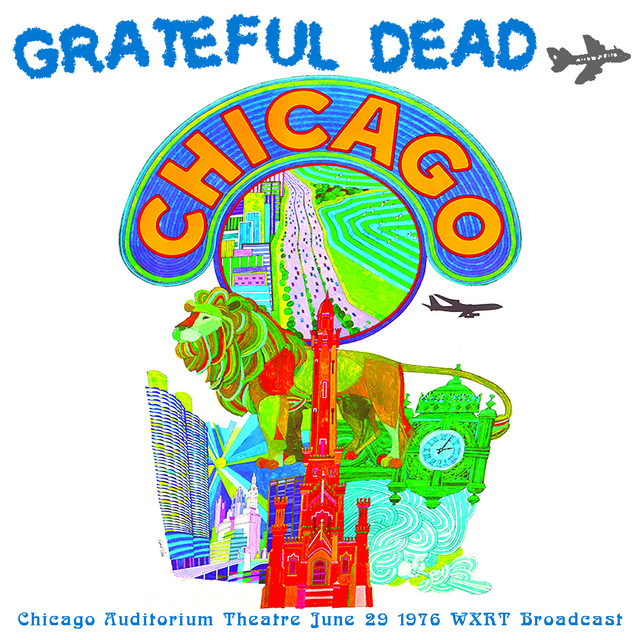
The Grateful Dead from June 29, 1976 at the Auditorium Theatre in Chicago, IL is Don's Pick Tonight
 DJ Don Edwards
Summer ’76 in Full Bloom: Why the Grateful Dead’s June 29, 1976 Chicago Performance Remains One of the Most Underrated Gems of the Post-Hiatus Era. Among devoted Grateful Dead fans, few periods inspire as much fascination as the summer of 1976. The band had returned from its extended touring hiatus refreshed, focused, and musically transformed. Gone were some of the frenetic excesses that characterized portions of the early 1970s. In their place emerged a more patient, nuanced, and sophisticated approach to live performance that allowed songs to breathe, arrangements to evolve, and improvisation to develop organically. While legendary performances from June and July of 1976 are often celebrated among collectors, one concert continues to stand out as an especially rewarding listen nearly fifty years later: the Grateful Dead’s June 29, 1976 appearance at Chicago’s historic Auditorium Theatre.
Captured on one of the most treasured sources in Grateful Dead collecting circles—a pristine Betty Cantor soundboard master that was also broadcast over WXRT-FM—the performance serves as a remarkable example of a band operating at a uniquely creative crossroads. It is a show filled with elegant transitions, carefully constructed setlists, strong individual performances, and the type of relaxed confidence that defined the Grateful Dead’s celebrated post-hiatus renaissance.
The Auditorium Theatre provided the perfect setting for the band’s evolving sound. Unlike the massive stadiums and arenas that would increasingly define the Grateful Dead’s touring life in later years, the Chicago venue offered an intimate environment where subtle musical details could flourish. Every note, every vocal harmony, and every improvisational turn felt magnified by the room itself. The result was a performance that rewards attentive listening and showcases a band rediscovering the joy of collective musical conversation.
From the opening moments, the Grateful Dead establish an atmosphere that would define the evening. Rather than launching into a high-energy rocker, they ease into the show with “Tennessee Jed,” a choice that perfectly reflects the band’s 1976 mindset. The performance is warm, conversational, and deeply rooted in the Americana influences that had always served as a foundation beneath the group’s more exploratory tendencies.
That sense of confidence continues through a beautifully sequenced first set. “Cassidy” arrives early and immediately demonstrates how much the band’s songwriting and arrangement work had matured. Bob Weir’s increasingly sophisticated compositions fit naturally alongside established classics, and the song’s dynamic structure provided ample room for the ensemble’s growing interplay.
One of the true highlights of the opening set comes with “Peggy-O.” By 1976, the Grateful Dead had transformed the traditional folk ballad into one of their most emotionally compelling performance pieces. Jerry Garcia’s guitar work on this version is particularly striking, combining lyrical phrasing with a remarkable sense of restraint. Rather than overwhelming the song with technical flourishes, Garcia allows the melody and storytelling to guide the performance, creating a version that remains deeply moving decades later.
The momentum continues through “Mama Tried” and one of the evening’s most intriguing selections, “Mission In The Rain.” Although often associated with Garcia’s solo projects, the song feels perfectly at home in the context of this performance. Its inclusion provides a welcome reminder of the creative overlap between the Grateful Dead and Garcia’s broader songwriting world during this fertile period.
The first set also features strong renditions of “Looks Like Rain” and “Brown Eyed Women,” but it is the pairing of “Lazy Lightnin'” and “Supplication” that truly captures the adventurous spirit of the era. The suite showcases Weir’s increasingly ambitious compositional approach while allowing the band to explore rhythmic and harmonic territory that set them apart from virtually every other touring act of the time.
“Row Jimmy” delivers another emotional centerpiece before the first set closes with a triumphant pairing of “The Music Never Stopped” and “Might As Well.” Both songs feel particularly suited to the celebratory atmosphere of the summer 1976 tour. By the time the first set concludes, the audience has already experienced a masterclass in pacing, variety, and musical sophistication.
The second set opens with a burst of energy courtesy of “Samson and Delilah.” The gospel-infused rocker immediately elevates the room’s intensity and reminds listeners that while the Grateful Dead’s 1976 sound may have become more polished, the band remained fully capable of delivering powerful, high-energy performances when the moment called for it.
A gorgeous version of “Candyman” follows, highlighting Garcia’s ability to inhabit a song completely. His vocal delivery is heartfelt and unforced, while the accompanying instrumental work demonstrates the exceptional listening skills that had become a hallmark of the band’s post-hiatus approach.
The centerpiece of the second set arrives through an expansive “Playing In The Band” sequence that flows gracefully into “The Wheel” before returning to a reprise of “Playing In The Band.” This sequence exemplifies everything that makes 1976 Grateful Dead performances so compelling. Rather than pursuing chaos or intensity for its own sake, the band constructs a patient and deliberate improvisational journey that rewards close attention. Themes emerge, evolve, disappear, and return in ways that feel entirely organic.
For many listeners, however, the true highlight of the evening comes later with the unforgettable sequence of “Saint Stephen,” “Not Fade Away,” and a return to “Saint Stephen.” During the mid-1970s, “Saint Stephen” had already become one of the most cherished songs in the Grateful Dead catalog, and its appearance always generated excitement among fans. Here, the band uses the song as a launching point for one of the evening’s most satisfying stretches of music.
The transition into “Not Fade Away” taps directly into the communal spirit that always defined the Grateful Dead experience. More than a cover song, “Not Fade Away” had become a shared ritual between band and audience, a moment where the boundaries between performers and listeners dissolved into a collective celebration. Returning to “Saint Stephen” afterward creates a sense of narrative completion that elevates the entire sequence.
As the evening moves toward its conclusion, “One More Saturday Night” delivers the expected burst of energy and excitement before the band returns for an encore performance of “U.S. Blues.” The choice feels especially appropriate. With its uniquely American imagery, playful lyricism, and infectious energy, the song serves as a fitting exclamation point on a performance that balances musical sophistication with pure entertainment.
Part of what has helped this concert endure among collectors is the extraordinary quality of the surviving recording. Captured from Betty Cantor’s legendary soundboard master and carefully restored over the years, the audio provides listeners with remarkable clarity and depth. Every instrument is presented with exceptional balance, allowing modern audiences to appreciate the subtle details that often define the best Grateful Dead performances.
The preservation work completed on the recording has also helped address various technical imperfections, ensuring that contemporary listeners can experience the show in a form that closely reflects the original broadcast and performance. The result is one of the finest available listening documents from the summer of 1976.
Tonight, this remarkable concert takes center stage on Don’s Pick, the popular Saturday night radio program dedicated to exploring exceptional live performances from across the musical spectrum. Hosted by Don, the show has become a destination for listeners who appreciate thoughtfully curated concerts, deep archival discoveries, and performances that reveal new insights with every listen.
Few selections embody the spirit of Don’s Pick better than the Grateful Dead’s June 29, 1976 performance at the Auditorium Theatre. It is a show that rewards both longtime Deadheads and newcomers alike. Veterans of the tape-trading era will appreciate the pristine source material and historical significance, while newer listeners will discover a band operating at an extraordinarily creative peak.
Nearly fifty years after the Grateful Dead walked onto the stage in Chicago, the performance remains a testament to the unique chemistry that made the band such an enduring force in American music. It captures a group that had already achieved legendary status yet continued pushing itself creatively every night. It documents a moment when patience, maturity, and musical curiosity combined to produce something truly special.
For anyone seeking to understand why the summer of 1976 occupies such a cherished place in Grateful Dead history, this concert provides a near-perfect introduction. The songs are strong. The performances are inspired. The recording is exceptional. Most importantly, the music still feels alive.
And nearly half a century later, that may be the greatest measure of all.