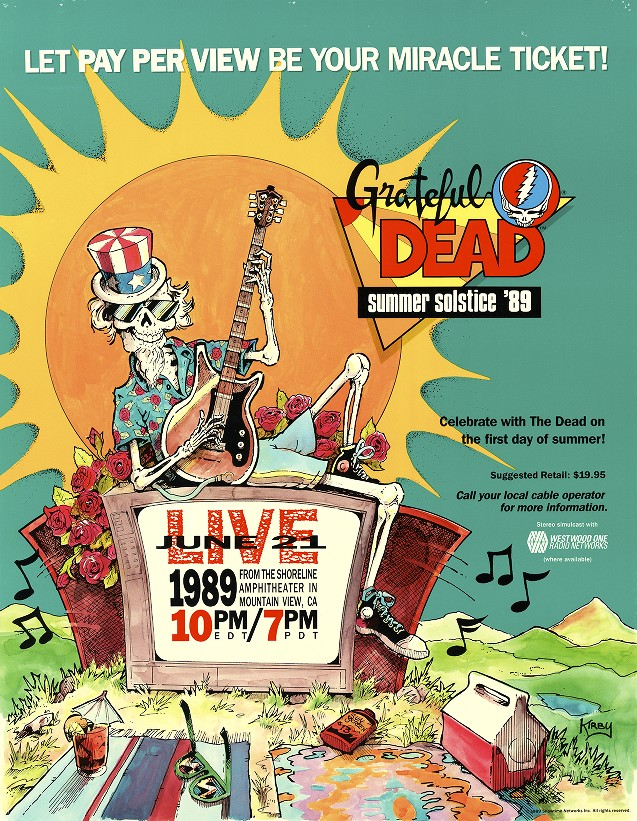
The Grateful Dead's June 21, 1989 from the Shoreline Amphitheatre is Don's Pick
 DJ Don Edwards
Summer Solstice Magic: Why the Grateful Dead’s Historic June 21, 1989 Shoreline Amphitheatre Broadcast Remains One of the Defining Performances of the Late-Eighties Revival. Every era of Grateful Dead history has its landmark performances. There are the primal explorations of the late 1960s, the jazz-infused adventures of Europe ’72, the majestic stadium years of the late 1970s, and the remarkable resurgence that defined the band’s final great creative peak during the late 1980s. Among the standout performances from that latter period, few concerts occupy a more important place in Grateful Dead lore than the Summer Solstice show performed on June 21, 1989, at Shoreline Amphitheatre in Mountain View, California.
For many Deadheads, the date immediately conjures memories of a band operating at an extraordinary level. Jerry Garcia was energized, Brent Mydland was delivering some of the strongest performances of his career, the band was drawing larger audiences than ever before, and the Grateful Dead machine was entering a period that would ultimately become one of the most commercially successful chapters in its history. Yet the significance of this particular show extends far beyond the music itself. June 21, 1989 represented a technological milestone, a cultural event, and a defining moment that demonstrated just how far the Grateful Dead had traveled from the ballrooms and theaters of the 1960s.
The concert marked the band’s first-ever live Pay-Per-View television broadcast, a groundbreaking event that carried the Grateful Dead experience into living rooms across America. Simulcast to hundreds of cable systems and numerous FM radio stations nationwide, the performance offered fans who could not make the pilgrimage to California an opportunity to experience the magic in real time. In an era long before livestreaming, social media, and on-demand digital content, the broadcast felt revolutionary. For one night, the Grateful Dead transformed a concert into a national event.
The setting itself could hardly have been more fitting. The Shoreline Amphitheatre had quickly become one of the band’s favorite venues and would eventually become synonymous with the Grateful Dead’s late-career success. Located in the heart of Northern California, not far from the band’s home base, Shoreline felt less like a concert venue and more like an extension of the Grateful Dead community itself. Every summer, the amphitheater became a gathering place where music, culture, and community merged into a uniquely Deadhead experience.
What makes the June 21 performance so enduring is that the band rose to the occasion. Rather than delivering a safe, television-friendly set designed for a broader audience, the Grateful Dead performed exactly as they always had: adventurous, spontaneous, and deeply committed to the moment. The result was a concert that showcased everything that made the band one of the most beloved live acts in American music.
The first set opens with “Hideaway,” immediately signaling that this would not be a predictable evening. The instrumental workout allowed the band to establish its collective chemistry before moving into a crowd-pleasing run of songs that highlighted the remarkable balance between classic material and newer favorites. “Touch of Grey” reminded viewers why the Grateful Dead had recently achieved an unprecedented level of mainstream visibility, while “New Minglewood Blues” and “Ramble On Rose” demonstrated the band’s continued connection to American roots traditions.
Throughout the first set, Jerry Garcia appeared particularly engaged. His performances on “Dire Wolf,” “When I Paint My Masterpiece,” and “Row Jimmy” showcased the warmth and melodic precision that defined much of his late-1980s playing. At the same time, Brent Mydland’s contributions on keyboards and vocals continued to elevate the band’s overall sound. By 1989, Mydland had become an essential creative force within the Grateful Dead, bringing energy, confidence, and emotional depth to virtually every performance.
The first set closes with a powerful “Deal,” a song that had become one of the band’s most reliable showstoppers. As Garcia’s guitar lines accelerated toward the song’s climactic ending, it became clear that the Grateful Dead were fully locked in and ready for an even bigger second set.
What followed remains one of the most celebrated stretches of music from the band’s late-period catalog.
The arrival of legendary saxophonist Clarence Clemons instantly transformed the dynamic of the evening. Best known for his work with Bruce Springsteen and the E Street Band, Clemons brought a completely different voice into the Grateful Dead’s musical universe. His powerful saxophone lines added texture, soul, and excitement while never overwhelming the band’s established chemistry.
Beginning with “Scarlet Begonias,” Clemons became an integral part of the performance. The interaction between Garcia, Mydland, and Clemons created one of the defining musical conversations of the evening. Deadheads still point to the “Scarlet Begonias” jam as one of the standout moments of the entire concert, with Garcia and Mydland exchanging ideas while Clemons floated effortlessly through the evolving arrangement.
“Hell in a Bucket,” “Ship of Fools,” and “Estimated Prophet” all benefited from Clemons’ presence, but it was “Eyes of the World” where the collaboration truly reached another level. Long regarded as one of the Grateful Dead’s greatest vehicles for improvisation, “Eyes” became a playground for exploration as Clemons injected fresh energy into a composition already known for its expansive possibilities.
The second set’s progression through “Drums” and “Space” into “Truckin’,” “The Other One,” and a stunning “Morning Dew” demonstrated why so many fans consider 1989 one of the strongest years of the late Grateful Dead era. The band moved seamlessly between structured compositions and open-ended improvisation, maintaining momentum while continually finding new pathways through familiar material.
“Morning Dew” in particular stands as one of the emotional peaks of the evening. Garcia’s vocal delivery carries a sense of gravity and urgency, while the band’s gradual build creates the type of dramatic tension that made the Grateful Dead’s best performances so unforgettable. Even decades later, the rendition remains one of the most frequently revisited moments from the concert.
The second set concludes with a joyous “Turn On Your Love Light,” once again featuring Clarence Clemons as a major contributor. The celebratory atmosphere captures the essence of what made the Grateful Dead experience unique. The music was never simply about technical execution. It was about creating a shared moment between performers and audience, and few songs embodied that spirit more completely.
For the encore, the band delivered “Brokedown Palace,” one of the most beloved songs in the entire Grateful Dead catalog. Its placement at the end of such a monumental evening provided a moment of reflection and emotional release. The song’s themes of farewell, gratitude, and journey felt especially poignant following a performance that had connected so many people across the country through a groundbreaking broadcast.
Looking back today, the June 21, 1989 Shoreline Amphitheatre concert represents far more than a successful Pay-Per-View experiment. It stands as a snapshot of a band enjoying one of its last great creative peaks. The chemistry between Garcia and Brent Mydland was flourishing. The group remained adventurous while benefiting from years of collective experience. The audience was growing. The cultural impact was expanding. Most importantly, the music itself continued to evolve.
The concert also serves as a reminder of how effectively the Grateful Dead embraced innovation without sacrificing authenticity. While many artists approached television broadcasts and special events with caution, the Grateful Dead treated the occasion like any other concert. They trusted the music, trusted the audience, and trusted the process.
Tonight, this historic Summer Solstice performance takes center stage on Don’s Pick, the beloved Saturday night radio program that has become a destination for listeners seeking extraordinary live recordings and carefully curated musical experiences. Hosted by Don, the show continues introducing fans to performances that capture the magic, unpredictability, and emotional depth of live music at its finest.
Featuring the complete June 21, 1989 Shoreline Amphitheatre broadcast, tonight’s edition of Don’s Pick offers listeners an opportunity to revisit one of the defining concerts of the Grateful Dead’s late-career renaissance. Whether you experienced the original Pay-Per-View event, traded tapes during the years that followed, or are discovering the performance for the very first time, the show remains a powerful reminder of what made the Grateful Dead unlike any other band in American music history.
More than three decades later, the Summer Solstice broadcast continues to stand as one of the great achievements of the late-eighties Grateful Dead. It captured a band at full strength, embraced emerging technology without compromising artistic integrity, and delivered a performance worthy of the national spotlight.
The cameras may have stopped rolling, but the music never stopped.