
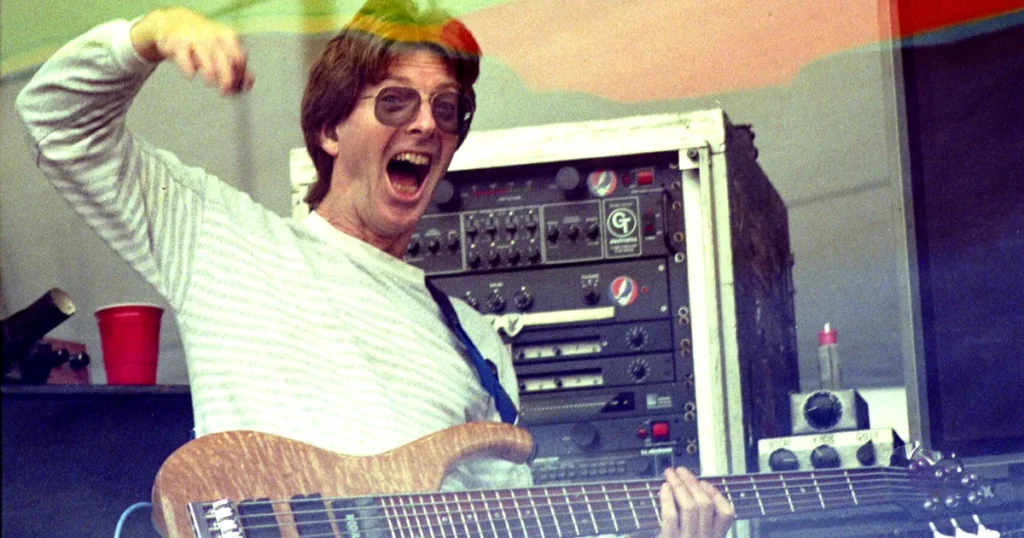
There is a single sentence that explains more about what Phil Lesh and Friends became, and why it mattered so much to everyone who was part of it, than any setlist or lineup announcement or archival recording ever could. Warren Haynes, the guitarist and vocalist who served as one of the most consistent and creatively essential presences in the rotating ensemble Phil Lesh built in the years after the Grateful Dead, revealed that sentence in a recently published interview retrospective that has been circulating through the community this month. When Phil Lesh first assembled the musicians who would become Phil and Friends, before the first rehearsal, before the first setlist was discussed, before any practical question about the project was addressed, he stated his one foundational rule: “I don’t want to do anything the way the Grateful Dead did it in the past, embrace the unknown.”
Six words, and a philosophy. A philosophy that explains why Phil and Friends produced music that consistently surprised even its most devoted followers, that drew in musicians from every corner of the American improvisational tradition, that refused to become a nostalgia project even when the entire commercial and cultural logic of the moment would have supported, even rewarded, exactly that kind of comfortable looking backward. And a philosophy that, as Haynes made clear in his July 10, 2026 Instagram post reflecting on the directive, continues to shape how the Lesh family approaches the catalog today, in the choices Grahame Lesh makes about how to present his father’s music and legacy to the audiences who keep showing up for it.
Tonight, the Phil and Friends Radio Show on The Grateful Dead Live brings that philosophy into your speakers, and understanding what Lesh demanded of every musician who passed through his ensemble is the best possible preparation for what the show offers.
What Phil Lesh Actually Built, and Why It Was Different From the Start
To appreciate why Lesh’s founding directive was so significant, it helps to understand the pressure against which he was asserting it. When the Grateful Dead ceased operations following Jerry Garcia’s death in August 1995, the community that had formed around thirty years of live performance found itself in a moment of acute uncertainty. The music that had structured so much of so many people’s lives was no longer being made by the people who had made it, and the question of what came next had no obvious answer.
The easiest and most commercially sensible answer would have been a straightforward continuation, a Phil and Friends lineup playing the catalog the way the Dead had played it, drawing on the deep reservoir of fan familiarity with specific arrangements and specific interpretive traditions to provide something comfortable and recognizable. That approach would have worked. It would have sold tickets. It would have made people happy in the modest but real way that faithful reproduction of beloved material makes people happy.
Lesh rejected it entirely, not as a strategic calculation but as an artistic conviction. His understanding of what the Grateful Dead had always been at their best was not a band that played songs in a particular way but a band that used songs as invitations to discover something, that treated the live performance context as an opportunity for genuine exploration rather than the execution of a blueprint. Building Phil and Friends around the principle of reinterpretation rather than replication was not a departure from the Dead’s values. It was the most faithful possible expression of them.
The musicians who worked with Phil and Friends over the years were not chosen for their ability to impersonate Garcia or to recreate specific historical moments. They were chosen for their own distinct musical personalities, for what they brought to a song that nobody else would bring, for the ways their individual voices would bend the material in directions that couldn’t be predicted in advance. That is why the Phil and Friends discography is not a collection of increasingly faithful Dead recreations but a genuinely varied body of work that sounds different from ensemble to ensemble, from night to night, from moment to moment within a single set.
Warren Haynes is the example that most vividly illustrates what this approach produced. His guitar playing carries the full weight of his Southern rock and blues roots, the Allman Brothers vocabulary, the specific harmonic sensibility that he developed over years of working in contexts very different from the Grateful Dead’s. When he applied that vocabulary to a Garcia composition or a Dead standard, the result was not Garcia’s version and not a pale imitation of Garcia’s version but something genuinely third, something that revealed dimensions of the song that the original approach had left implicit. Lesh heard that quality in Haynes and built a creative partnership around it that lasted years and produced some of the most rewarding live music of the post-Garcia era.
The Warren Haynes Revelation and What It Means for the Catalog Now
Haynes’s decision to share Lesh’s founding directive publicly, through a detailed Instagram post on July 10, 2026, is not an act of casual archival reminiscence. It is a statement about how Phil’s philosophy is being carried forward by the people now responsible for stewarding the catalog, and it arrives at a moment when the question of that stewardship is more actively debated than at any point since Phil and Friends began.
The philosophy has officially become, as Haynes framed it, the blueprint for how the Lesh family manages both the tape vaults and the modern tribute lineups. That is a significant statement with practical implications. It means that the recordings being drawn upon for archival releases and radio programming are being selected and presented with an awareness of what the music was trying to do rather than simply what it documented. It means that the musicians involved in current and future Lesh family projects are being chosen and directed according to the same principle of individual personality over replication that Phil articulated at the very beginning.
And it means that Grahame Lesh, who has been the most publicly active of Phil’s children in terms of performing and presenting his father’s music, is operating with an explicit philosophical inheritance rather than simply a sentimental one. The band Grahame assembled for the Golden Gate Park free concert on Labor Day, featuring Holly Bowling, Garrett Deloian, Scott Law, Danny Eisenberg, Brian Rashap, and Danny Luehring, reflects this inheritance directly. These are musicians with their own distinct voices, their own musical biographies, their own ways of hearing the catalog that differ from each other and from the historical reference points. They are not trying to sound like the Grateful Dead. They are trying to do what the Grateful Dead always did, which is a different and considerably more demanding thing.
The distinction Haynes drew between replication and reinterpretation is one that the broader community has been negotiating since Garcia’s death, and his articulation of it carries particular authority because of his own role in demonstrating what reinterpretation actually sounds like when it’s done with genuine commitment. His Guitar Slingers project and his work with Gov’t Mule have always operated on the same principle, which is why Lesh sought him out in the first place and why their collaboration produced such consistent creative results.
Phil Lesh as Bassist: What Made Him Irreplaceable
The Phil and Friends Radio Show exists in part to keep this understanding alive, and one of the things it does most effectively is return listeners again and again to the specific qualities of Phil Lesh’s playing that no other musician in the band’s universe replicates or could replicate. Understanding what Lesh actually did as a bassist, as distinct from what a conventional rock bassist does, is essential to understanding why his presence was so central to the Grateful Dead’s sound and why every ensemble that has attempted to present the catalog in his absence has had to find its own solution to the creative space his playing occupied.
Lesh did not approach the bass as a rhythmic support instrument. He approached it as a melodic and harmonic voice of equal standing with the guitars and keyboards, one that could move independently of the rhythm section’s foundational function, that could engage in direct melodic conversation with Garcia’s lead playing, that could create unexpected harmonic colors by moving into territory that conventional bass playing treats as off-limits. The result was a bottom end that was simultaneously more unpredictable and more structurally adventurous than anything in the mainstream rock tradition, and it gave the Grateful Dead a rhythmic and harmonic flexibility that no other band of their era could match.
This approach required the musicians around Lesh to adjust in ways they often found initially disorienting. Rhythm guitar, in the context of a bass player who might be doing anything at any moment, cannot simply lay down predictable chord stabs and trust the bass to stay out of the way. Lead guitar, in conversation with a bassist actively contributing melodic material, has more voices to respond to and a richer harmonic environment to work within. Lesh’s unconventional approach was not merely an individual stylistic choice. It was an organizing principle that shaped the entire ensemble’s behavior.
In the Phil and Friends context, this meant that every new configuration of musicians had to find its own relationship to what Lesh was doing, and no two configurations found exactly the same relationship. That variety, that ongoing negotiation between Phil’s bass and whatever musicians surrounded him at a given moment, is what makes the Phil and Friends recordings so consistently worth returning to and so generously served by a dedicated radio program.
The Rotating Cast and What It Revealed About the Catalog
The musicians who moved through Phil and Friends over the years constitute a remarkable cross-section of American improvisational music, and the list tells a story about the breadth of Lesh’s musical vision and the range of contexts in which the Dead’s material could productively find itself.
Warren Haynes and Jimmy Herring brought the Southern rock and blues tradition into direct contact with the California psychedelic vocabulary. Trey Anastasio, whose own Phish built a musical philosophy significantly influenced by the Dead, worked alongside Phil in configurations that allowed the two traditions to examine each other from the inside. John Scofield applied the specific harmonic intelligence of jazz guitar to material that had always moved in jazz-adjacent directions without fully committing to the jazz idiom, and the results were revelatory in ways that neither purely jazz nor purely rock approaches could have produced independently.
Bob Weir’s periodic appearances in Phil and Friends lineups allowed the original rhythm guitar voice of the Grateful Dead to participate in a context explicitly designed around the principle of not doing things the way the Dead had done them, which created a productive tension between historical familiarity and exploratory intent that generated some of the most interesting live moments in the ensemble’s history. Jackie Greene and Larry Campbell brought country and folk sensibilities that illuminated the American roots dimensions of songs that are often presented primarily as psychedelic rock. Donna Jean Godchaux, whose vocals were inseparable from the Dead’s own sound during her tenure with the band, brought a continuity of feeling that grounded the more experimental moments in something emotionally immediate and warm.
The keyboards chairs were filled over the years by musicians including Bruce Hornsby, Melvin Seals, T Lavitz, and Rob Barraco, each bringing a fundamentally different approach to what keyboards can do in an improvisation-centered band. The conversations between those different keyboard voices and Lesh’s bass constitute some of the deepest and most instructive listening available anywhere in the catalog.
The Tape Vaults and the Ongoing Archival Mission
One practical consequence of Phil Lesh’s founding philosophy, and of the Haynes articulation of that philosophy that Grahame’s stewardship continues, is that the tape vaults of Phil and Friends recordings represent an archive that is considerably more varied and surprising than a straightforward catalog of Dead covers would be. Every recording is a document of a specific musical conversation between specific personalities at a specific moment, and because those personalities were chosen for their distinctiveness rather than their compatibility with a predetermined approach, the archive reflects an extraordinary range of musical outcomes.
The Phil and Friends Radio Show is ideally positioned to draw on that archive in ways that reveal its depth, moving between lineups and eras and musical contexts to demonstrate not just the consistency of the catalog’s appeal but the variety of ways in which that appeal can be realized. A Haynes and Herring lineup attacking the same song that Trey Anastasio approached in a different configuration will not produce the same performance. Hearing both, understanding why each sounds the way it does, developing a feel for how the individual musicians’ voices shaped the musical outcome, is one of the most instructive listening experiences available to anyone who wants to understand what makes the Grateful Dead’s catalog so durably rewarding.
The Lesh family’s current management of the vaults, according to the framework Haynes described, is guided by an awareness of this variety as the archive’s most important quality. Releases and programming are being shaped by the question of what reveals the catalog’s depth rather than what presents it most accessibly or most commercially, and that orientation is the direct continuation of the principle Phil articulated at the beginning: embrace the unknown, not as a slogan but as an operational commitment to discovering what the music can be rather than confirming what it already was.
Why the Phil and Friends Radio Show Belongs in Your Weekly Listening
The Phil and Friends Radio Show occupies a specific and valuable position in the broader landscape of Grateful Dead-related radio programming on The Grateful Dead Live, and that position reflects a genuine understanding of what Lesh’s project added to the catalog that the original band, for all its extraordinary qualities, could not have provided.
Phil and Friends was the laboratory where the post-Garcia question of how to continue the music without its most famous voice was worked out in real time, in front of audiences, through the evidence of actual performance rather than theoretical discussion. The solutions that laboratory produced were varied, sometimes surprising, consistently illuminating, and permanently documented in recordings that keep rewarding deeper listening. The radio show brings those recordings into the present tense, presenting them not as historical artifacts but as living documents of a musical intelligence that is still relevant to every question about how the Grateful Dead’s legacy should be approached and presented.
For longtime fans, the show offers access to Phil and Friends performances that many never had the opportunity to hear live, and the curatorial intelligence that goes into selecting recordings reflects the same commitment to revealing the catalog’s depth rather than merely confirming its familiarity that guided Phil’s ensemble choices from the beginning.
For newer listeners, it offers an introduction to a dimension of the Dead’s musical universe that the original band’s recordings, however extraordinary, cannot fully convey, because the conditions under which Phil and Friends operated, the explicit commitment to approaching the material from a genuinely new angle every time, produced something that the original context could not produce.
Warren Haynes put it as plainly as it can be put when he shared Phil’s founding directive this month. Embrace the unknown. That was the instruction then, and it is the spirit in which the Phil and Friends Radio Show presents this music now.
Tonight is the right night to hear what that spirit sounds like.

