The Terrapin Roadshow is a traveling concert series created by the Lesh family to carry forward the musical legacy and community ethos established by Phil Lesh, the iconic bassist and founding member of the Grateful Dead. In 2026, that mission takes on renewed significance, as the series expands into a multi-city run that reaffirms not only the durability of the Grateful Dead songbook, but the living, evolving culture that surrounds it.
Rather than functioning as a tribute or static recreation, the Terrapin Roadshow operates as a continuation of the principles that defined the original movement. The music is not preserved—it is reinterpreted. The performances are not replicated—they are rebuilt in real time. Each show is constructed through a rotating ensemble of musicians drawn from across the modern jam landscape, creating a fluid, collaborative environment where improvisation remains central to the experience.
2026 Tour Schedule & Lineup Highlights
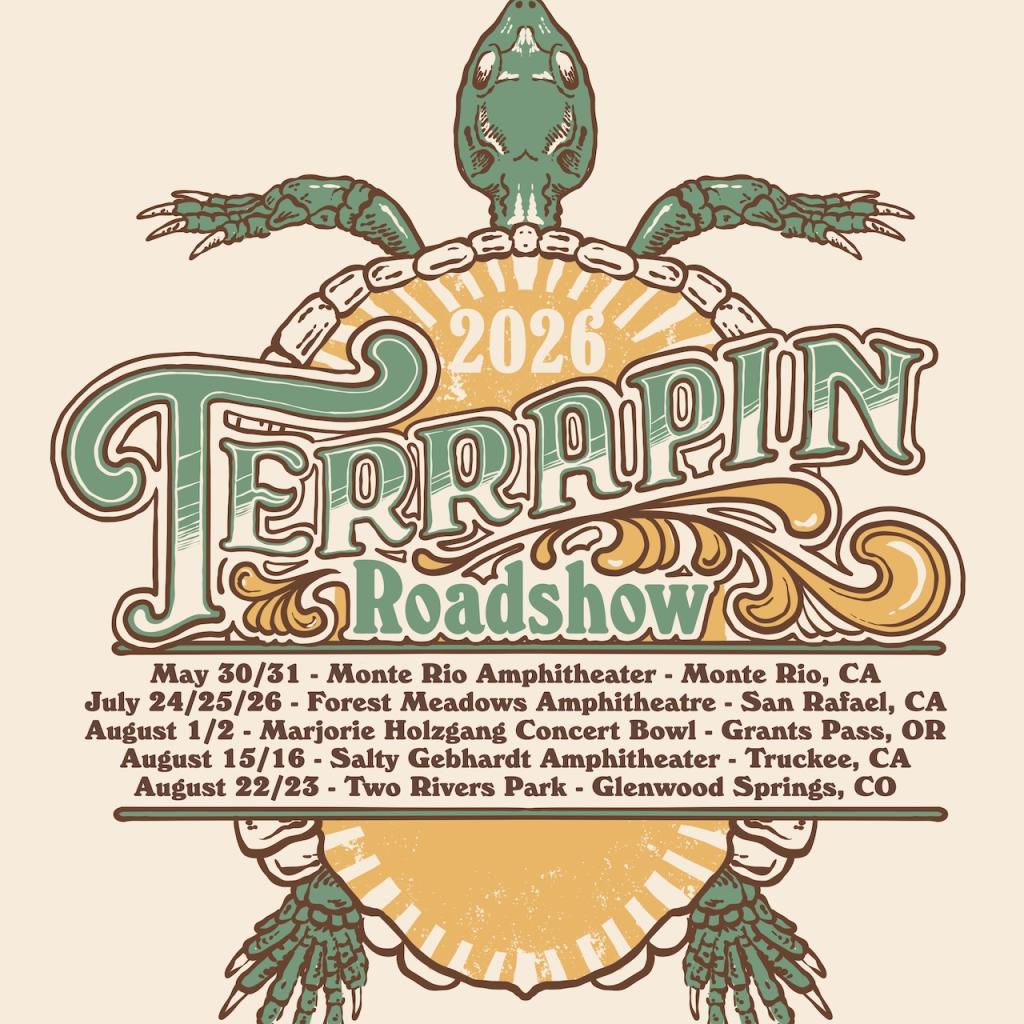
The 2026 series kicks off in late May and runs through August. Full details and tickets can be found on the Terrapin Roadshow official site.
| Date(s) | Location | Featured Performers |
|---|---|---|
| May 30–31 | Monte Rio, CA | Jackie Greene, Lebo, Elliott Peck, The Wolf Pack |
| July 24–26 | San Rafael, CA | Nicki Bluhm, Stu Allen, Reed Mathis, Barry Sless |
| August 1–2 | Grants Pass, OR | Scott Law, Holly Bowling, Kanika Moore, Garrett Deloian |
| August 15–16 | Truckee, CA | Amy Helm & The Helm Family Midnight Ramble Band |
| August 22–23 | Glenwood Springs, CO | Bill Nershi, Kyle Hollingsworth, Ross James, Mark Levy |
This approach reflects the core philosophy Phil Lesh brought to the Grateful Dead and later to his own projects. His role was never limited to traditional bass playing; it was structural, melodic, and deeply conversational. That influence remains embedded in the Roadshow, where every performance emphasizes interplay, responsiveness, and the willingness to let songs evolve organically rather than adhere to fixed arrangements.
The 2026 Terrapin Roadshow begins in late May and extends through August, covering eleven dates across five key locations in the western United States. Each stop features a distinct lineup, reinforcing the idea that no two nights are designed to be the same. The opening run in Monte Rio, California brings together Jackie Greene, Lebo, Elliott Peck, and The Wolf Pack, setting a tone that blends familiarity with forward motion. From there, the series moves into San Rafael, where the connection to the original Terrapin Crossroads runs deepest, before continuing through Grants Pass, Truckee, and Glenwood Springs with an expanding roster of performers that includes members of The String Cheese Incident, Trey Anastasio Band, and other cornerstone acts within the improvisational community.
What defines these performances as much as the music itself is the environment. The Roadshow deliberately avoids large-scale, impersonal venues in favor of intimate outdoor amphitheaters—spaces that allow for direct engagement between artist and audience. Whether set among redwoods or positioned along rivers, these locations recreate the atmosphere that once defined Terrapin Crossroads, where the boundary between performer and listener was intentionally minimal. The result is an experience that prioritizes connection over spectacle, reinforcing the communal identity that has always been central to this music.
The structure of each show is rooted in the Grateful Dead catalog, but it is not confined by it. Deep cuts, extended transitions, and spontaneous improvisation define the setlists, ensuring that the material remains alive rather than archival. Songs shift in tone and direction depending on the players involved, the environment, and the energy of the audience. This variability is not incidental—it is the defining characteristic of the format.
Parallel to the live experience, the Phil & Friends Radio Show continues to serve as a critical extension of this legacy. Through a curated rotation of live recordings and collaborative performances, the show provides a broader context for Phil Lesh’s musical impact, highlighting both his original work and the ongoing reinterpretations that keep it relevant. It functions as both a historical archive and a forward-facing platform, connecting past performances with present-day evolution.
The relationship between the Radio Show and the Roadshow is intentional. One documents and contextualizes the music; the other expands it in real time. Together, they form a continuous loop that sustains the Grateful Dead tradition without reducing it to nostalgia. This dual structure ensures that the music remains both accessible and dynamic, capable of reaching new audiences while maintaining its core identity.
Ticketing for the 2026 Roadshow reflects the project’s emphasis on accessibility and community. General admission pricing is positioned to encourage broad participation, while VIP options provide additional engagement for those seeking a more immersive experience. This balance mirrors the ethos of the series itself—open, inclusive, and rooted in shared experience rather than exclusivity.
In the current live music landscape, where legacy acts often rely on replication or scale, the Terrapin Roadshow presents a different model. It demonstrates that continuity does not require sameness, and that a catalog as expansive as the Grateful Dead’s can remain vital when approached with intention and flexibility. The music is not being preserved in place—it is being carried forward.
What the Lesh family has created is not just a tour, but a framework for ongoing evolution. The Terrapin Roadshow ensures that the spirit of the Grateful Dead remains active, not as a fixed point in history, but as a living system that continues to adapt, expand, and resonate.