The modern Grateful Dead universe continues evolving into something far larger than a legacy concert scene. What once revolved around a single touring band has now transformed into a sprawling national ecosystem of collaborative musicians, traveling communities, improvisational festivals, multimedia art experiences, archival preservation projects, sustainability initiatives, symphonic reinterpretations, and intergenerational live performance culture. Nowhere is that transformation more visible than inside the rapidly expanding world surrounding the Terrapin Roadshow, which officially launches its highly anticipated 2026 summer season next weekend with a massive two-night outdoor gathering designed to embody the communal spirit, musical spontaneity, and immersive atmosphere that have defined Grateful Dead culture for generations.
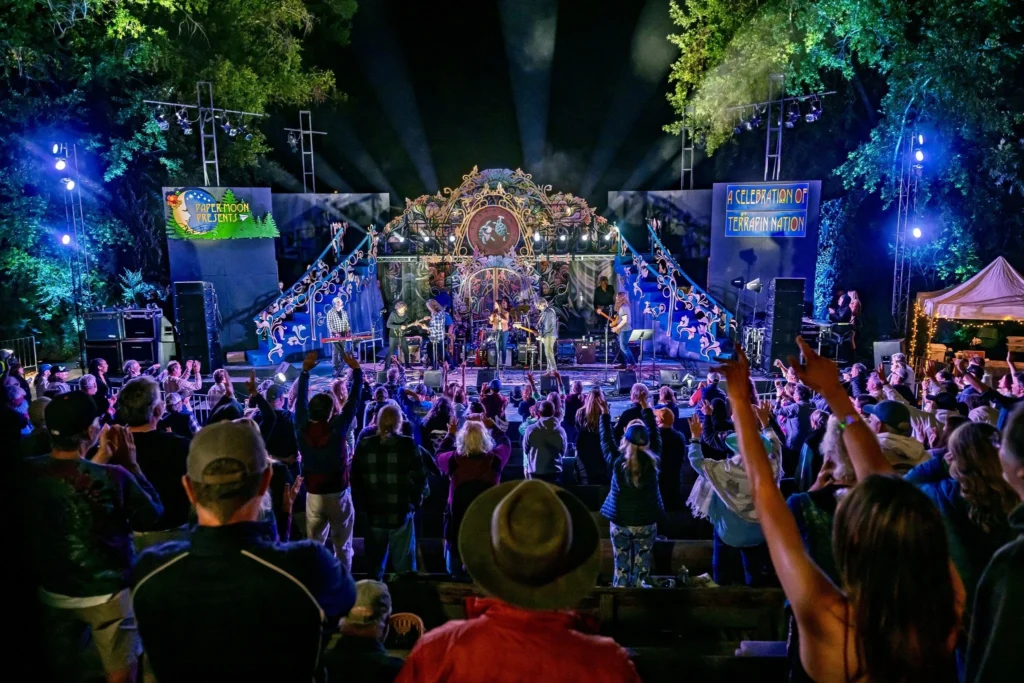
Presented by The Grateful Dead Live in partnership with Paper Moon Presents and the extended Terrapin Crossroads community, the opening weekend arrives on Saturday, May 30, and Sunday, May 31, at the picturesque Monte Rio Amphitheater in Northern California. The venue itself feels uniquely appropriate for the event’s philosophy. Nestled among towering trees and deeply connected to the natural beauty of Sonoma County, the amphitheater reflects the type of open-air communal gathering spaces that have long served as the emotional backbone of the broader Grateful Dead live experience.
But the Terrapin Roadshow is not attempting to recreate the past. It is building something contemporary out of the same ideals that once fueled the original Deadhead movement — musical freedom, collaboration, improvisation, community connection, artistic experimentation, environmental awareness, and shared cultural experience. That distinction matters because the modern Grateful Dead universe is no longer operating as a nostalgia circuit alone. It has become one of the last major live music communities in America still centered around unpredictability, musician interaction, and collective participation rather than rigidly programmed entertainment.
The Monte Rio kickoff weekend is being structured as a fully immersive outdoor gathering rather than a conventional concert presentation. Organizers are leaning heavily into the classic family-friendly festival atmosphere that longtime Deadheads instantly recognize: open grounds, collaborative performance structures, communal interaction, visual art activations, improvisational set flow, and the feeling that every attendee is participating in a temporary traveling cultural village rather than merely attending a ticketed event.
Saturday’s opening-night schedule begins with doors opening at 4:00 PM before music launches at 5:00 PM, immediately setting the tone for what promises to be a long-form improvisational evening under the Northern California sky. The opening night will feature acclaimed psych-rock and funk-driven trio Skip The Needle serving as the official opening act, bringing an energetic and exploratory sonic palette into the larger collaborative environment of the evening.
Sunday’s format expands even further into a full-day communal gathering, with doors opening earlier at 1:00 PM and music beginning at 2:00 PM. That afternoon lineup opens with rising progressive bluegrass favorites AJ Lee & Blue Summit, whose genre-blending style perfectly aligns with the Americana roots traditions that have always existed at the core of the Grateful Dead songbook. Their inclusion reinforces one of the most important truths about the current Dead-inspired scene: the culture surrounding this music has always embraced stylistic fluidity rather than strict genre boundaries.
At the center of the weekend stands a carefully curated all-star collaborative ensemble designed specifically for the Monte Rio performances. Rather than operating as a static touring band, the Terrapin Roadshow continues the Grateful Dead tradition of fluid musician interaction, rotating lineups, spontaneous combinations, and evolving performance chemistry.
Leading the ensemble is Grahame Lesh, whose growing role within the extended Grateful Dead community continues carrying enormous symbolic and musical weight. As the son of legendary bassist Phil Lesh, Grahame occupies a uniquely important bridge between generations of Dead culture. But what has increasingly defined his presence is not simply lineage. It is his commitment to continuing the collaborative and improvisational values that made the Grateful Dead experience unlike any other touring phenomenon in American music history.
Joining the lineup is Jackie Greene, whose blend of roots rock, Americana, blues, and improvisational storytelling has made him one of the most respected crossover musicians within the extended Dead universe. Greene’s ability to move seamlessly between folk intimacy and expansive jam-driven exploration continues making him an ideal fit for projects built around musical spontaneity.
Also featured is Dan Lebowitz — better known throughout the jam-band community as Lebo — whose psychedelic guitar work and improvisational versatility have long made him a favorite collaborator across countless Dead-affiliated projects. Keyboardist Mookie Siegel, vocalist Elliott Peck, and drummer Jeremy Hoenig round out a lineup specifically assembled for expansive musical interaction rather than rigid song recreation.
One of the weekend’s most ambitious elements arrives through the inclusion of the Wolfpack strings and horns configuration, featuring orchestrational contributions and arrangements from respected players including Brian Switzer, Adam Theis, Alex Kelly, Sheldon Brown, and Mads Tolling. Their participation continues the growing movement inside the Grateful Dead universe toward increasingly layered and symphonic reinterpretations of the catalog, echoing the broader orchestral preservation efforts that have emerged around the music in recent years.
What makes these expanded arrangements especially important is how they reflect the continuing evolution of Grateful Dead music itself. The catalog is no longer confined to rock-band performance structures. It is increasingly being interpreted through jazz ensembles, chamber orchestras, bluegrass collectives, brass configurations, folk collaborations, and hybrid improvisational formats that treat the music as a living American songbook rather than a fixed set of recordings.
The broader event footprint also demonstrates how modern Dead-inspired gatherings are becoming fully immersive cultural experiences extending far beyond the stage itself. The 2026 Terrapin Roadshow season includes a major partnership with Fat Tire as part of the company’s 35th anniversary celebrations. But unlike traditional corporate sponsorships that often feel disconnected from the spirit of live music communities, the integration here is being designed around experiential activations that complement the broader environmental and communal philosophy surrounding the event.
Throughout the Monte Rio grounds, attendees will encounter outdoor adventure installations, interactive visual art exhibits, sustainability-focused initiatives, and communal gathering spaces integrated directly into the amphitheater environment itself. These additions reflect the increasingly holistic direction of modern Grateful Dead-inspired events, where environmental awareness, artistic experimentation, and community participation operate alongside live performance rather than separately from it.
That environmental dimension has become especially central to the modern Grateful Dead community in recent years. Long before sustainability branding became standard practice throughout the music industry, the Deadhead community already functioned around ideas tied to communal coexistence, grassroots organization, alternative economies, and ecological consciousness. The Terrapin Roadshow appears intent on carrying that philosophy forward into a contemporary touring framework that feels relevant to modern audiences without abandoning the spirit that originally built the culture.
The larger significance of the Terrapin Roadshow’s continued growth may ultimately extend far beyond any individual concert weekend. What events like Monte Rio demonstrate is that the Grateful Dead community remains one of the only major musical subcultures in America capable of continuously regenerating itself across generations without relying entirely on legacy nostalgia. Younger audiences continue discovering the music through collaborative live performance. Veteran Deadheads continue finding new interpretations inside familiar songs. Musicians continue treating the catalog as a platform for exploration rather than preservation alone.
That philosophy remains deeply connected to the broader ecosystem surrounding Grateful Dead-inspired media, live radio programming, and community storytelling platforms. Across the extended universe of Grateful Dead Live programming, listeners continue engaging with tribute performances, archival releases, improvisational broadcasts, and artist-focused explorations that preserve not only the music itself but the deeper cultural values embedded within it.
The Terrapin Roadshow ultimately represents the next evolution of that living culture. Not a tribute act. Not a nostalgia package. Not a reenactment of another era. It is a continuation of an idea — the belief that music can still function as an open-ended communal experience where improvisation, emotional risk, artistic freedom, and human connection matter more than perfection or predictability.
In an entertainment landscape increasingly dominated by algorithms, automation, pre-programmed productions, and disposable content cycles, gatherings like the Terrapin Roadshow feel almost radical in their commitment to spontaneity and shared experience.
And as the Monte Rio Amphitheater prepares to welcome thousands of fans into another weekend built around improvisation, collaboration, and collective musical discovery, one thing becomes increasingly clear: the Grateful Dead universe is not fading into history.
It is still growing.