
The legacy of the Grateful Dead has never been confined to music alone, but in 2026 it reaches a new level of cultural and industry-wide significance—one defined not just by sound, but by responsibility. What was once a revolutionary live music movement has matured into a forward-facing model for sustainability, artistic independence, and long-term impact, led in no small part by Bob Weir, whose influence continues to shape both the stage and the systems that support it.

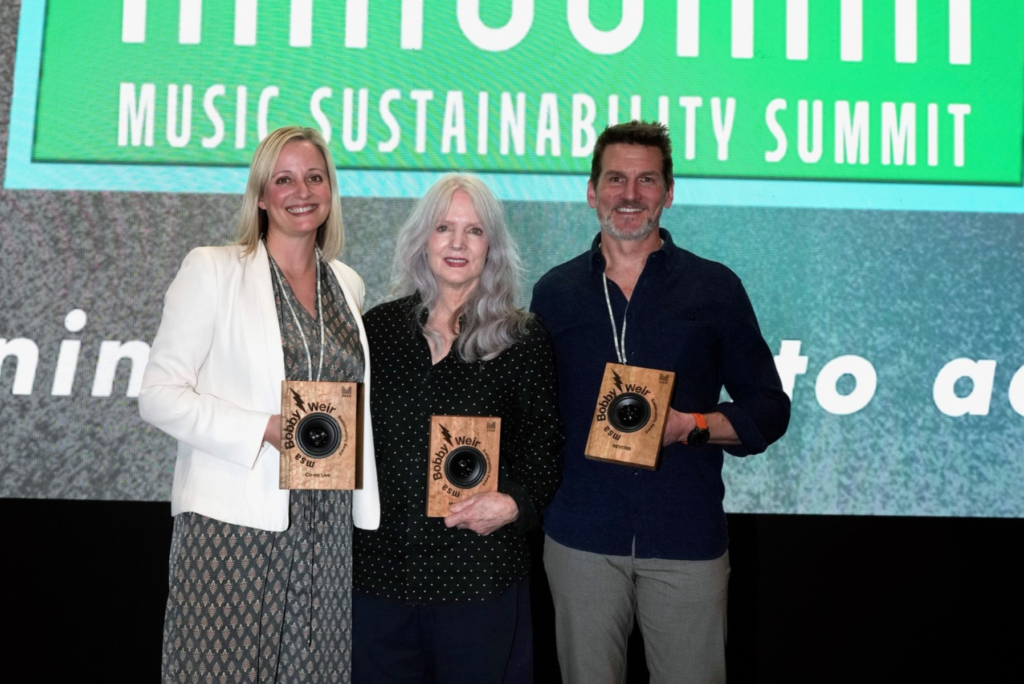
This year marks a defining moment with the official launch of the MSA Bobby Weir Sustainability Awards—an initiative introduced by the Music Sustainability Alliance to recognize transformative leadership in environmentally responsible music practices. Known informally as “The Bobbys,” the awards were established to honor Weir’s lifelong commitment to environmental stewardship, a philosophy that has quietly underpinned the Grateful Dead ecosystem for decades but is now being formally recognized, quantified, and scaled across the industry.
The inaugural ceremony, held on March 31, 2026, and presented during the Music Sustainability Summit in Los Angeles on April 14, 2026, signaled a shift from conversation to execution. These awards are not symbolic gestures—they are operational benchmarks. They reflect a growing understanding that the live music industry, long associated with excess and waste, can be reengineered into a model of sustainability without sacrificing scale, energy, or cultural relevance.
Among the inaugural honorees, Co-op Live stands as a proof-of-concept for what modern venues can achieve, operating on 100% clean electricity while maintaining a zero-waste model that redefines efficiency at scale. REVERB was recognized for its sweeping impact across more than 450 tours, embedding sustainability into touring infrastructure and proving that environmental responsibility can be systemic, not situational. Maggie Baird was honored for her work integrating climate-positive practices into global touring through her organization Support + Feed, demonstrating how advocacy and execution can operate in tandem.
Even the awards themselves reflect the ethos they celebrate. Crafted from reclaimed wood sourced from fallen trees in Los Angeles, they are physical embodiments of a guiding principle that has defined Weir’s worldview: leave nothing behind but the experience. It is a philosophy that now moves beyond rhetoric into replicable practice, influencing how artists, promoters, and venues approach every layer of live production.
This expansion into sustainability does not exist in isolation—it is deeply connected to the broader Grateful Dead universe, where music, culture, and values operate as a unified system. That connection is perhaps most vividly experienced through The Ace Radio Show, an immersive broadcast dedicated to exploring the musical identity and evolution of Bob Weir. More than a retrospective, the show is a living archive—one that traces the threads between Weir’s work with the Dead, his solo catalog, and his ongoing creative output.
The Ace Radio Show is a mesmerizing journey into Weir’s musical universe, blending rock, folk, and Americana into a narrative that feels both deeply personal and universally resonant. For listeners, it offers context—an understanding of how the same artist who helped define improvisational rock has also become a leading voice in environmental advocacy. The show reinforces that these two elements are not separate chapters, but parallel expressions of the same ethos: awareness, connection, and responsibility.
What emerges in 2026 is a fully realized ecosystem where the Grateful Dead’s legacy operates across multiple dimensions. The live performance tradition continues to inspire, the sustainability movement now carries institutional weight through the MSA Bobby Weir Sustainability Awards, and The Ace Radio Show serves as the connective tissue, bringing audiences into a deeper understanding of the philosophy that drives it all.
This is not a retrospective moment—it is an expansion. The Grateful Dead are no longer just a band to be remembered; they are a model to be followed. And through Bob Weir’s continued leadership, that model is evolving into something even more significant: a blueprint for how music can exist in harmony with the world it inhabits, without losing an ounce of its power, spontaneity, or soul.

